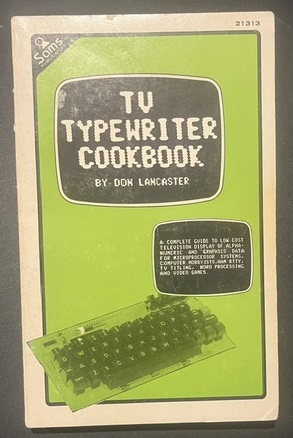
Don Lancaster's The TV Typewriter Cookbook is one of the books that defined the 1970s hobbyist bench. Howard W. Sams published it in 1976. 256 pages. It took the TV Typewriter Lancaster introduced in his September 1973 Radio-Electronics article and turned it into a complete build-it-yourself guide. For the first time, ordinary hobbyists could add real text display to a homebrew computer for under $150, using a household television. That is how a cheap TV became a working video terminal.
Don Lancaster (1939-2023), the same author as the TTL Cookbook and CMOS Cookbook, wrote this to fill a gap. The 1973 Radio-Electronics article showed a simple TV Typewriter. The response was heavy enough that he expanded it into a full Sams cookbook in 1976. It stayed in print for years and sat next to the other Cookbook titles on the same shelf.
The book is organized for hands-on use. Chapter 1 covers what a TV typewriter is, configurations, TV scanning, dot-matrix character generation, ASCII and Baudot, and operating principles. Chapter 2 is a catalog of useful integrated circuits. Later chapters cover memory (low-cost RAM and ROM for screen storage), timing and sync generators, keyboard encoders and interfacing, serial interfaces including UARTs and cassette storage, direct video and RF television output, hard-copy options, and color graphics. The construction chapters cover several TV Typewriter designs - the TVT-1, TVT-2, and TVT-3 variants - plus troubleshooting and expansion.
Lancaster showed how to generate stable video sync, store a full screen of characters (typically 16 lines of 32 characters), use inexpensive MOS character generators such as the 2513, and interface the result to machines like the Mark-8 or Altair 8800. Total parts cost was often under $100 if you already owned the TV. The book included schematics, parts lists, PC board patterns, and construction notes. A commercial CRT terminal cost hundreds. This was a weekend and a parts order.
Before cheap CRT terminals, homebrew machines talked through lights, a Teletype, or nothing. This book gave hobbyists affordable video on a kitchen-table budget and made interactive computing realistic. It fed SWTPC video, Altair interfaces, and the habit of using a TV as a monitor. In the MicroBasement the worn copy sits with the EME-1, the SWTPC CT-1024, the Digital Group video card, the Mark-8, and the other Lancaster cookbooks.