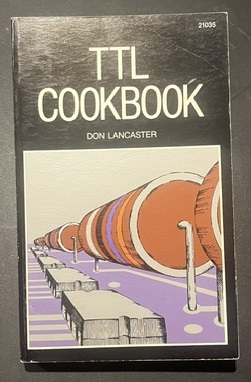
Few books shaped hands-on digital electronics like Don Lancaster's The TTL Cookbook. Howard W. Sams published it in 1974 (Sams 21035). 335 pages. It turned datasheets into circuits you could wire: counters, clocks, displays, interfaces. In the MicroBasement it sits with the other Lancaster cookbooks and the TTL machines they explain.
Don Lancaster (1939-2023) wrote the Cookbook series - RTL (1969), TTL (1974), CMOS (1977), Active Filter, TV Typewriter - plus hundreds of magazine pieces. Clear, cheap, and aimed at people with a breadboard. The TTL Cookbook stayed in print for decades and sold on the order of a million copies. It is the book a lot of Mark-8, Altair, and homebrew builders actually had open on the bench.
Chapter 1 is TTL itself: gates, packages, supplies, breadboards, fan-out, decoupling. Chapter 2 is a working catalog of the common 7400-series parts. Later chapters cover logic tricks (DeMorgan, tri-state, ROMs), timers and Schmitt circuits, clocked JK and D flip-flops, divide-by-N, shift registers, noise, rate multipliers, then a pile of whole projects in Chapter 8 - counters, frequency meters, music, TV typewriters. Appendix of vendors.
Unlike dry manufacturer databooks, The TTL Cookbook explains exactly how each circuit works, highlights common pitfalls, and provides real-world application examples. It covers positive logic conventions, fan-in/fan-out rules, power decoupling, and even ASCII code tables. The emphasis is always on building working hardware quickly and reliably, making it the perfect companion for anyone constructing early microcomputer kits, interfaces, or custom digital instruments.
The TTL Cookbook put working digital design in the hands of people who did not have a company databook library. That is the moment hobbyists started thinking in gates. In the MicroBasement the worn copy sits with the TTL chips, the Mark-8, and the Altair hardware - a reminder that a lot of modern computing started as a Sams paperback on a kitchen table.