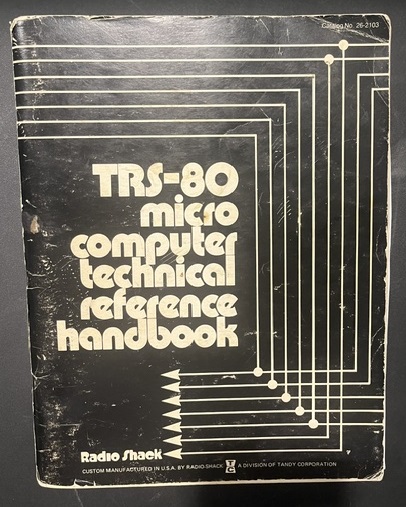
Radio Shack catalog 26-2103. Tandy Corporation, 1978-79. About 108 pages, 8.5 by 11, sold for $9.95. This is the Model I hardware book: block diagram, memory map, theory of operation, adjustments, troubleshooting flowcharts, expansion-port pinout, parts list, and fold-out schematics for Level I and Level II. Not a BASIC tutorial. Radio Shack assumed you already had the Level I or Level II manual. This one is for the person who wanted to know why the cassette relay clicked and how the video chain made 64 characters on a television.
In that period a serious machine often shipped with, or offered as a catalog extra, real technical paper: schematics, memory maps, bus timing, connector pinouts, and a parts list with Radio Shack or industry numbers. The owner was expected to repair it, to understand it, and to hang something on the side that the factory never sold. That is how the S-100 cards, the Apple II slots, the PET user port, and the TRS-80 expansion edge existed. The documentation was part of the product.
That habit is what people mean by open architecture. The bus is published. The schematic is published. Third parties can build a disk controller, a clock, a printer port, or a weird sensor box without asking Tandy for a blessing. Closed architecture is the opposite: no schematic, no documented bus, fasteners that fight you, and a license that says only the vendor touches the inside. Repair becomes a depot. Extension becomes an app store. The iPhone on the comm shelf is the closed end of that line. This handbook is the open end, sold over the counter at Radio Shack for ten dollars.
The preface says it will not teach digital logic. It will teach this computer. Contents, in order:
BYTE reviewed it in September 1979 and called the theory-of-operation chapter the real substance, especially the video logic. That matches the book: if you have ever wondered how a Model I makes a display without a CRT controller chip, those pages are the answer.
Titus's Interfacing Books 1 and 2 tell you what to hang on the expansion connector. This handbook tells you what that connector is electrically, what the Z80 is doing each cycle, and which resistor to turn when the picture rolls. Together they are why a Model I could grow a disk, a printer, a real-time clock, or a home-built port without becoming a brick. Radio Shack sold the computer as a consumer product. They also sold the drawing of the inside. That combination is rare now and was already getting rare then.
Sits with the Model I page, TRS-80 Interfacing Books 1 and 2, and the other Radio Shack paper. The technical reference is the factory's own admission that the owner was allowed to know.