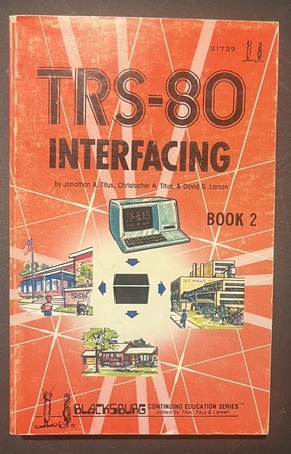
Jonathan A. Titus's TRS-80 Interfacing Book 2 builds directly on Book 1 and takes TRS-80 owners into more advanced hardware control and data acquisition. Published in 1980 by Howard W. Sams & Co. (ISBN 0-672-21739-2), this 256-page paperback expanded the toolkit with analog signals, precise timing, serial communication, and multi-device systems. It showed how to turn the TRS-80 into a laboratory instrument, controller, or data logger while keeping the designs practical, low-cost, and buildable at home. In the MicroBasement collection this sequel sits beside Book 1, the TRS-80 hardware, and Titus's Mark-8 pages.
Jonathan A. Titus, the Mark-8 designer and author of TRS-80 Interfacing Book 1, published this volume in 1980, again in the Blacksburg Continuing Education Series from Howard W. Sams. Drawing on readers who had finished Book 1, he moved into more complex applications, deeper Z-80 programming, and newer peripherals. The book was aimed at Model I and Model III owners ready to go past simple I/O ports into measurement and automation.
It opens with a review of the TRS-80 expansion bus and Z-80 signals, then covers analog-to-digital and digital-to-analog conversion (chips such as the ADC0808 and DAC0808), precise timing and event counting, serial RS-232 with UARTs such as the TR1602, interrupt-driven I/O, multi-channel data acquisition, stepper motor control with feedback, and opto-isolated interfaces for safer real-world hookups. Later chapters cover polling versus interrupts, data buffering, error checking, and complete examples: digital voltmeters, frequency counters, environmental monitors, and automated test equipment. Schematics, timing diagrams, parts lists, Z-80 assembly, and troubleshooting notes run through the book.
Titus kept the parts list in the common TTL and linear drawer and added isolation where the bench met the outside world. Code examples cover BASIC and assembly. Projects scale from a temperature sensor or relay driver up to a multi-channel system. He spends time on bus noise, ground loops, and timing skew - the problems that actually show up once you leave the LED box. Most builds stayed in the $50 to $100 parts range.
Book 1 got you onto the expansion connector. Book 2 is analog, serial, interrupts, and measurement. Together they sit with the Model I and Model III class hardware, the Mark-8, and the other Blacksburg Sams volumes. That is the TRS-80 as a controller, not only as a BASIC box.