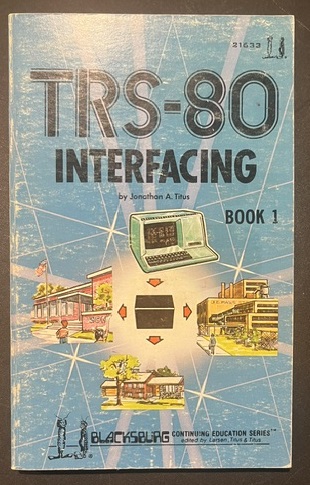
Jonathan A. Titus's TRS-80 Interfacing Book 1 is a cornerstone for turning the TRS-80 from a game-playing appliance into a versatile hardware platform. Published in 1979 by Howard W. Sams & Co. (ISBN 0-672-21633-7), this 192-page paperback provided detailed, practical guidance on connecting the TRS-80 Model I to the outside world - sensors, relays, displays, printers, and more. It showed hobbyists and experimenters how to build custom interfaces using TTL logic, simple circuits, and assembly-language programming, and it proved the TRS-80 could be far more than a BASIC machine. In the MicroBasement collection this book sits beside the Model I hardware and the Titus Mark-8 pages.
Jonathan A. Titus, the designer of the Mark-8 Minicomputer from the July 1974 Radio-Electronics article, wrote this book as part of the Blacksburg Continuing Education Series. Howard W. Sams published it in 1979 (some printings listed as 1980). It was aimed at TRS-80 owners who wanted to expand beyond cassette games and BASIC. Titus drew on his microcomputer interfacing work to produce a step-by-step guide to the Model I expansion bus and I/O.
The book is organized for hands-on builders. It begins with an overview of the TRS-80 Model I architecture: the Z-80 microprocessor, memory map, keyboard, video, cassette interface, and expansion port signals. Chapters cover decoding the address bus, using the expansion port for parallel I/O, building simple input/output ports with TTL latches and buffers (74LS series), handling interrupts, generating control signals, and interfacing to real-world devices like switches, LEDs, relays, stepper motors, analog-to-digital converters, and digital-to-analog converters. Later sections include timing considerations, power supply needs, breadboarding techniques, and assembly-language programming examples for controlling those interfaces. Full schematics, timing diagrams, parts lists, and code snippets are in the book.
Titus emphasized low-cost, reliable designs using common TTL ICs and modest wiring. He explained how to access the TRS-80 expansion bus without damaging the machine, how to decode specific addresses for custom ports, and how to write Z-80 code to read and write data. Projects ranged from simple LED flashers and switch readers to digital voltmeters, motor controllers, and data loggers. The book is usable by a beginner and still has enough depth for an experienced builder to hang serious peripherals on a Model I.
Book 1 gave Model I owners a working path from the expansion connector to sensors, displays, and control. Book 2 continues that path. Together they sit with the TRS-80 hardware, the Mark-8, and the other Blacksburg Sams volumes. The TRS-80 in this collection is not only a Level II BASIC box. This book is a large part of why.