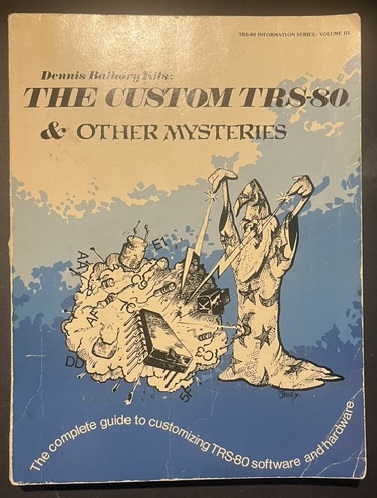
Dennis Bathory-Kitsz. IJG, Inc., Upland, California, February 1982. Volume 3 of IJG's TRS-80 Information Series. 335 pages. ISBN 0-936-20002-2. Cover price $29.95. First printing sold out in a month; about 50,000 copies across three printings. This is the Model I hardware-hacking book: open the case, cut a trace, add a clock, hang a second keyboard, put high-resolution graphics on a machine that was never designed for it, and when it crashes, work through 111 cures.
Radio Shack sold a computer. The expansion box, the RS-232 board, and a few catalog extras were the official options. After that you were on your own. That was normal. S-100 had a bus and a pile of vendors. The Apple II had slots. The Model I had an edge connector, a technical reference handbook, and a large population of people who did not wait for Tandy. Individuals wrote down what they had actually built, verified it on a real machine, and published the whole project - schematic, parts list, software, and the sentence that told you which etch to cut. That is a different artifact from a forum thread or a GitHub gist. The project had been through someone else's bench before it reached yours.
Dennis Bathory-Kitsz wrote the 80 Applications column in 80 Microcomputing and pieces for The Alternate Source. Some of this book started there. IJG - International Jewelry Guild, the same house that published H. C. Pennington's TRS-80 Disk and Other Mysteries - was not a computer company. They printed the books the official catalog would not. The Custom TRS-80 was late (promised for 1981, shipped February 1982). IJG ran an "Excuses, Excuses" ad and then sold it hard. David Moore edited. H. C. Pennington did the cover. The warranty page is honest: modify the machine and Radio Shack is done with you. The rest of the book assumes you already decided that.
A 1978 Model I out of the box is a Z80, Level I or II ROM, 4K or 16K of RAM, a cassette, a keyboard, and video on a television monitor. The expansion interface added more RAM, disk, printer, and RS-232 if you bought the board. That was the factory story. There was no slot cage. There was no sanctioned high-resolution graphics. There was no factory real-time clock, no second keyboard, no lowercase as a standard early feature, no 3.5 MHz speedup, no 8-track mass storage. If you wanted those things you built them, or you bought a kit from a small vendor who had read a book like this one. Closed architecture hides the bus and the schematic. Open architecture publishes them and then stands back. The Model I sat in the awkward middle: Radio Shack published the technical reference, then spent years watching the aftermarket climb in through the expansion connector and the case screws.
Eleven chapters and seven appendices. It starts with tools and a bench supply, then Getting Inside - what you see when the cover comes off, and how to put it back. From there:
Appendices: parts suppliers, bibliography, byte values, IC pinouts, and the other reference tables you need when the project is in pieces on the desk.
That is the difference from a lot of what gets published now. Kitsz does not hand you a block diagram and a wish. A chapter has the foil cuts, the IC numbers, the software listing, and the note about what breaks if you leave the XRX cassette mod in when you install a high-speed clock. Creative Computing's 1983 review called it a book for people willing to unscrew, cut, solder, and drill. That is accurate. It is also why the projects survived: someone else had already made the smoke come out once, wrote down which resistor did it, and printed the fix. The Alternate Source and 80 Micro were the magazines that fed this culture. This book is that culture bound.
Sits with the Model I, the Radio Shack Technical Reference Handbook, and Titus Interfacing Books 1 and 2. The Tandy book tells you what Radio Shack built. Titus tells you how to hang a port on the published connector. Kitsz tells you what happens after you accept that the factory options were not enough. Fifty thousand copies is a lot of opened Model I cases.