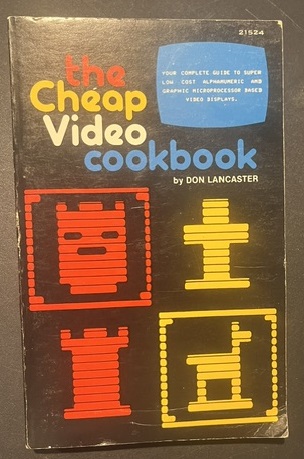
The Cheap Video Cookbook is Lancaster's low-budget sequel to the TV Typewriter Cookbook. Howard W. Sams published it in 1978. 256 pages. The TV Typewriter book still assumed a real character-generator ROM and a respectable parts pile. This one asked how little you could spend and still put readable text on a black-and-white television. Lancaster's answer was on the order of $20 to $30 in parts: a handful of TTL, a crystal, and timing tricks. That is the book that made a junk-drawer TV into a computer display.
Don Lancaster (1939-2023) followed the 1976 TV Typewriter Cookbook with this 1978 volume, again from Howard W. Sams. The audience was the experimenter who wanted video on an Altair, IMSAI, or homebrew board without buying a commercial terminal or a 2513 character generator. Same Sams format as TTL and CMOS: circuits you could wire, not a theory text.
It starts with how a consumer TV actually scans, how you generate horizontal and vertical sync, and how you form characters without an expensive ROM - including software character generation with shift registers and simple logic. Later chapters cover cheap sync generators built from 74LS counters and gates, video mixers, page memory in static RAM, rolling-display tricks that save RAM, cursor, scrolling, and crude block graphics. Complete schematics include the TVT-6 and related minimalist circuits, plus notes on microcomputer interface, keyboard, and cassette. Appendix: pinouts, ASCII, 1978 parts sources.
A typical Cheap Video screen was still about 16 lines by 32 characters. The parts list was short: 74LS161 counters, 74LS175 registers, a few gates, a crystal, resistors and capacitors. No character-generator ROM required if you accepted software-built glyphs. Circuits were forgiving enough to prototype on a breadboard. That is why it sold - a Lear Siegler still cost hundreds. This was a dozen TTL packages and a television you already owned.
Video was one of the expensive walls between a blinkenlight machine and an interactive computer. Cheap Video knocked the price of that wall down to pocket change. Sol-20 class displays, early Apple I video habits, and a lot of one-off 8080 / 6800 / 6502 homebrews sit downstream of these pages. In the MicroBasement it belongs with the TV Typewriter Cookbook, the EME-1, the SWTPC CT-1024, and the TTL drawer.