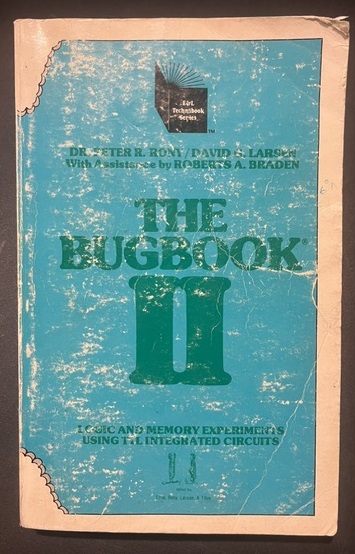
BUGbook II - Logic & Memory Experiments Using TTL Integrated Circuits - is a lab manual for digital electronics. Published in 1974 by E & L Instruments as part of the early BUGbook series (later printings through Howard W. Sams), it has more than 50 experiments on TTL gates, flip-flops, counters, shift registers, and memory. Two Virginia Tech authors. The hardware is an E & L breadboard or the Mini-Micro Designer (MMD-1) class trainer. In the MicroBasement collection BUGbook II sits beside the 8080A BUGbook, the TTL Cookbook, and the MMD-1.
Published in 1974 by E & L Instruments. Authors:
Rony and Larsen taught at Virginia Polytechnic Institute and State University (Virginia Tech) and built the BUGbook series to make digital electronics a lab subject instead of a lecture. BUGbook II is logic and memory. It follows BUGbook I on gates and combinational circuits and comes before the 8080A microprocessor volume.
More than 50 experiments. Each has objectives, theory, circuit diagrams, parts lists, step-by-step procedure, data tables, and review questions. It starts with the 7400-series family - characteristics, fan-in and fan-out, supplies, noise immunity - and moves to flip-flops (RS, JK, D), counters (binary, decade, up/down), shift registers (serial in/out, parallel load), and memory (static RAM, ROM uses, address decode). Experiments include astable multivibrators, ripple counters, synchronous counters, ring counters, Johnson counters, shift-register sequences, and small RAM arrays. Appendices: TTL pinouts, truth tables, breadboard notes.
The parts list is 74-series TTL, a breadboard, a supply, switches, LEDs, and a logic probe or scope. Wiring diagrams are meant to be built the same day. The authors spend time on bounce, race conditions, and reading a waveform instead of guessing. Experiments extend - presettable counters, more memory - without jumping to a new book. Classroom and kitchen-table both used it. A lot of people built their first digital project from these pages before they owned a microcomputer.
Bugbook II is the TTL lab. The 8080A BUGbook is the next step when the trainer grows a microprocessor. Lancaster's TTL Cookbook is the reference on the same parts. The MMD-1 on the shelf is the board these experiments were written around. That is the line from a 7400 gate to an 8080 front panel.