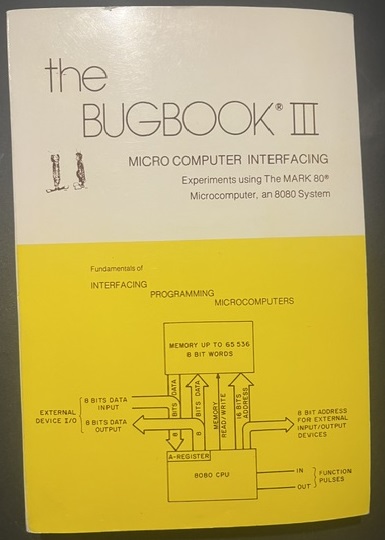
BUGbook III is the first of the series to put an 8080 on the bench. Full title: Microcomputer Interfacing Experiments Using the MARK 80 Microcomputer, an 8080 System. E & L Instruments published it in 1975. About 590 pages. Authors: David G. Larsen, Peter R. Rony, and Jonathan A. Titus. Bugbooks I and II were TTL - gates, flip-flops, counters, memory. III is the jump: program an 8080, talk to I/O, and breadboard it on the MARK 80 / Micro-Designer trainer. E & L sold the book for $14.95 and advertised sixty self-teaching experiments and a glossary of about two hundred microcomputer terms.
Published in 1975 by E & L Instruments, Derby, Connecticut - the same company that sold the MMD-1 and the earlier Bugbook hardware. Authors:
Larsen and Rony were on the Virginia Tech faculty. Titus designed the Mark-8 (Radio-Electronics, July 1974) and was already building 8080 trainers. The MARK 80 in the subtitle is an 8080 teaching computer, not the 8008 Mark-8. Later Sams volumes - the 8080A BUGbook (1977) and Bugbooks V and VI on the MMD-1 - grow out of this book. III is the E & L original.
Sixty experiments. The book assumes you can already wire TTL from Bugbooks I and II, then adds the 8080: instruction set, registers, memory map, fetch and execute, clock cycles, and timing loops. Interfacing chapters cover input and output ports, latches, three-state buffers, decoders, and how those parts hang on an 8080 bus. Programming experiments can be dry-labbed if you do not have the trainer; the interfacing work wants a MARK 80 or Micro-Designer and an outboard breadboard. Status signals, I/O timing, and the usual first-8080 surprises (when does the data bus actually hold still?) are in here. A glossary sits in the back so the new vocabulary has a home.
The point of III is not another chapter of 7400 theory. It is: load a program, single-step or free-run it, and watch a port change. E & L's trainer and the later MMD-1 exist so those labs do not require an Altair. Parts are still TTL plus the 8080 and a little memory. If you already finished Bugbook II, this is the next binder on the same bench. If you jumped straight to an 8080 kit, this is the lab manual that tells you what the status lights are trying to say.
Bugbook II is TTL logic and memory. Bugbook III is the 8080 on that same style of trainer. The 8080A BUGbook and the MMD-1 pages are the 1977 continuation. TEA and the 8080/8085 Software Design volumes are the programming shelf that grew after the labs. In this collection III belongs next to Bugbook II, the 8080A BUGbook, and the Mini-Micro Designer.