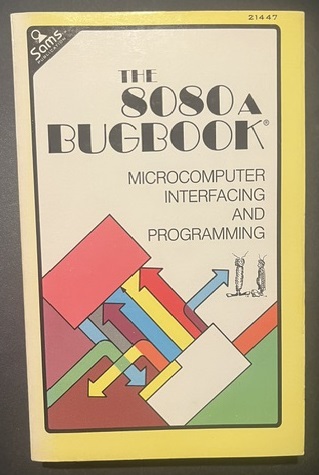
The 8080A BUGbook - often cited as Experiments in Microprocessor Applications: The 8080A Microprocessor - is a laboratory manual that put the Intel 8080 on the bench. Published in 1977 by Howard W. Sams & Co. as part of the Blacksburg Continuing Education Series, this 336-page paperback gives 30 experiments using the SDK-80 or a similar 8080 kit. Architecture, instruction set, interfacing, and applications are taught by wiring the circuit and running the code. In the MicroBasement collection the BUGbook sits beside the 8080/8085 Software Design series, the 8085A Cookbook, and the other Titus titles.
Published in 1977 by Howard W. Sams & Co. Authors:
All three taught at Virginia Polytechnic Institute and State University (Virginia Tech) and were central to the Blacksburg Continuing Education Series. The BUGbook was written as a companion to Intel's SDK-80 or equivalent 8080 hardware. Audience: college labs, self-learners, and anyone building a first 8080 system who needed more than a data sheet.
Thirty experiments. Each has objectives, background, circuit diagrams, parts lists, step-by-step procedure, data tables, and questions. It starts with basic 8080 operation - fetch/execute, register transfers, arithmetic and logic - and moves to interrupts, timing loops, memory-mapped I/O, parallel and serial interfacing (8255 PPI, 8251 USART), analog-to-digital conversion, stepper motors, keyboard/display (8279), and simple data acquisition. Experiments include delay loops, binary counters, BCD adders, interrupt-driven systems, serial communication, and process-control simulations. Appendices: 8080 instruction-set summary, pinouts, timing, SDK-80 wiring.
Every experiment assumes real hardware (SDK-80 or a breadboarded 8080), a short extra parts list (TTL, switches, LEDs, resistors), and assembly listings you can enter and run. Debugging is done with a scope or a logic probe. Timing waveforms and the usual failures - bus contention, interrupt priority - are part of the write-up. The labs scale from an LED blinker to an interrupt-driven I/O handler. A lot of people used this book to learn the 8080 before they touched an Altair, an IMSAI, or a controller of their own.
The 8080 powered the Altair 8800 and a pile of what followed. This book is how students and hobbyists made that chip fetch, execute, and talk to a port. It sits with the 8080/8085 Software Design volumes, TEA, the 8085A Cookbook, Bugbook II, and the 8080 hardware on the floor. Lab book first, theory second.