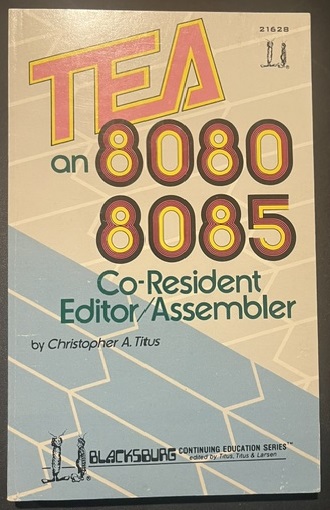
TEA (Tiny Editor/Assembler) by Christopher A. Titus is a compact tool for 8080/8085 builders who wanted to edit and assemble code on the same machine that would run it. Published in 1979 by Howard W. Sams & Co. (ISBN 0-672-21628-0) as part of the Blacksburg Continuing Education Series, this 256-page paperback is a co-resident editor and two-pass assembler that lived in memory beside the user's program. It turned a bare 8080/8085 system - Altair, IMSAI, SDK-85, homebrew board - into a development setup without paper tape, cassette, or a separate host. In the MicroBasement collection TEA sits beside the 8080/8085 Software Design books, the 8085A Cookbook, and the other Titus titles.
Christopher A. Titus, brother of Jonathan A. Titus (Mark-8 designer and TRS-80 interfacing author), was a Virginia Tech educator and a regular on the Blacksburg series with David G. Larsen and Peter R. Rony. TEA was published in 1979 by Howard W. Sams as a working companion to that group's microprocessor books. The subject of the book is TEA itself: a resident editor and two-pass assembler, with full source listings so you could load it, change it, or move it to another board.
Almost the entire book is TEA: design, how you run it, and the source. It opens with why a resident editor/assembler mattered on a standalone microcomputer. Chapters cover TEA's architecture, memory use (typically loaded in low RAM), the command set (line editing, insert/delete, search/replace, assemble), the symbol table, the two-pass assembly, error reporting, and listing options. The core is the complete hexadecimal source listing, commented, so you could enter it from a front panel, a tape, or a serial loader. Later sections cover customizing TEA, talking to a TTY or CRT, adding macros or conditional assembly, and running it on common 8080/8085 hardware. Appendices: opcode tables, ASCII, command summary.
TEA was small enough for limited RAM (often 4-8K), loaded quickly, and ran with modest I/O - a serial port or even a front panel. You typed source a line at a time, fixed mistakes on the machine, assembled in two passes, and jumped to the object code. The book has loading steps, notes on debugging TEA itself, and small example programs (utilities, I/O drivers). That is the point of co-resident: the editor and the user program share the same memory map. No second computer required.
Software Design Books 1 and 2 teach the instruction set and how to structure a program. TEA is the tool that lived on the board while you wrote that program. Together they sit with the 8085A Cookbook, the Bugbooks, and the 8080/8085 hardware. Same Blacksburg shelf, different job.