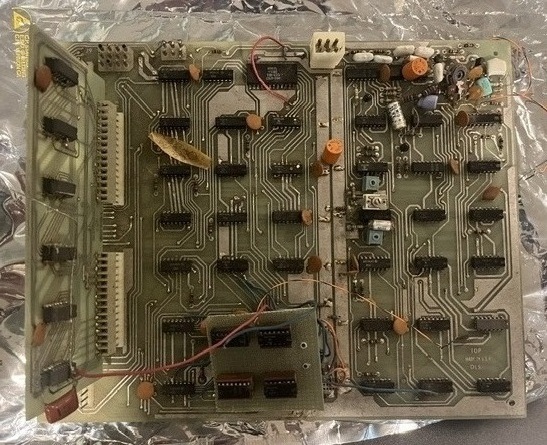
The Southwest Technical Products (SWTPC) CT-1024 was one of the first affordable video terminals designed specifically for hobbyists in the mid-1970s. Released as a kit, it allowed builders to create a complete ASCII terminal for use with early microcomputers like the Altair 8800. In the MicroBasement, the CT-1024 represents the dawn of practical home computing displays - a modular, build-it-yourself terminal that bridged the gap between crude TV Typewriters and modern video cards. This write-up covers what it is, its specifications, timeline fit in hobbyist video terminals, modularity with add-on cards, price, and original publication.
The CT-1024 is a character-based video terminal kit that converts serial data into a 16-line by 32-character (or 64x16) display on a standard TV or monitor. It was designed by Don Lancaster (author of the TTL Cookbook) and sold by Southwest Technical Products Corporation. It used TTL logic (no microprocessor in the base model) to generate video, making it simple yet powerful for the era. Users could connect it to any computer with RS-232 or TTL serial output, turning a TV into a full terminal for programming and data entry.
Key specs from the original design:
It supported cursor control, scrolling, and basic editing commands via serial input.
The CT-1024 was released in late 1974/early 1975 - just before the Altair 8800 (January 1975). It was one of the first practical, affordable video terminals for hobbyists, following crude TV Typewriter designs (Don Lancaster's 1973 Popular Electronics article) but preceding microprocessor-based terminals like the SWTPC CT-64 (1976). It filled a critical gap: early hobbyists could now have a real terminal instead of a Teletype or TV Typewriter hack. Its timing made it the go-to display for the first wave of personal computers.
The CT-1024 was designed for easy expansion:
This modular approach let builders start basic and upgrade as needed, keeping costs low while allowing customization — a hallmark of SWTPC kits.
The basic CT-1024 kit cost $275 in 1975 (about $1,600 in 2026 dollars), with the full package (keyboard, power supply, case) around $395. It was sold through SWTPC catalogs and Popular Electronics ads. Thousands were built by hobbyists, making it one of the most successful early terminal kits.
The CT-1024 was first published in Popular Electronics magazine (September 1974 issue) as a construction article by Don Lancaster. SWTPC then sold the kit, with full documentation, schematics, and parts lists provided in the magazine and kit manual. This open publication model was typical of the era and helped popularize home computing.
The CT-1024 was a pivotal step in making video terminals accessible to hobbyists, bridging the gap between TV Typewriters and modern monitors. In the MicroBasement, it stands as a testament to the DIY spirit of the 1970s - a modular, buildable terminal that let thousands of enthusiasts see their code on a screen for the first time. Its influence lives on in every modern computer display.