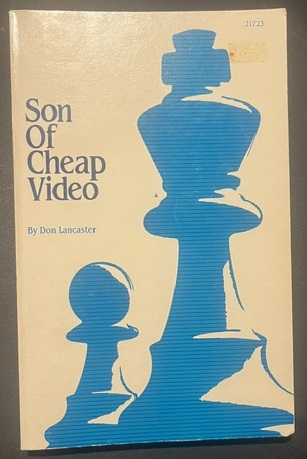
Son of Cheap Video is the 1979 sequel to The Cheap Video Cookbook. Subtitle on the cover: more TV typewriter and video display ideas. Howard W. Sams, 224 pages. The first Cheap Video book got readable monochrome text on a TV for about $20 to $30. This one is the refinement pass: tighter sync, better fonts, scrolling, cursor, a little color, and still a tiny parts count. Same audience - the person who already owned a television and did not want to buy a terminal.
Don Lancaster (1939-2023) published this a year after Cheap Video, again with Howard W. Sams. It is built on mail from the first book and on what 8080, 6502, and Z80 builders were actually asking for. It stayed in print into the 1980s. Same Sams bench style as TTL, CMOS, and the TV Typewriter Cookbook.
It opens with a review of cheap-video timing: sync, dot clocks, software-assisted characters. Then the upgrades - more stable sync generators, more readable fonts including proportional-spacing tricks, hardware scrolling and cursor, tighter use of cheap static RAM for page memory, direct color using simple resistor DACs (a crude 8 to 16 color palette), cleaner RF modulators, and better keyboard and display hookup. Schematics cover evolved TVT-6 style boards and new minimalist color circuits, plus troubleshooting, parts lists, and notes toward games and crude animation. Appendix: ASCII and Baudot, pinouts, 1979 sourcing.
Many of the builds still lived in the 16-by-32 neighborhood. Lancaster also showed how to push density and add blink, scroll, and low-res color without a commercial video board. Parts cost for a lot of the circuits stayed in the $25 to $40 range if you raided surplus. Breadboard-friendly. That is the point: Sol-20, TRS-80 class machines, Apple I/II video habits, and PET-era hobby boards were all cheaper if the display was a TV and a handful of 74LS parts.
Cheap Video made a screen possible. Son of Cheap Video made that screen less ugly and a little more like a terminal. Color and scroll at junk-box prices is why a lot of late-1970s homebrew machines stopped looking like front-panel trainers. In the MicroBasement it sits with Cheap Video, the TV Typewriter Cookbook, the EME-1, the SWTPC CT-1024, and the TTL drawer.