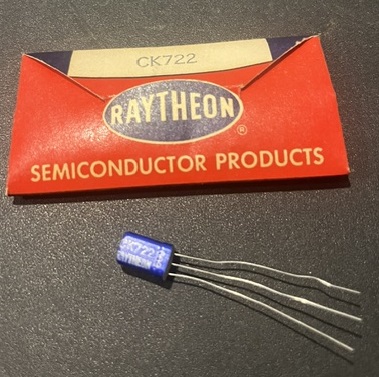
The CK722 is a PNP germanium alloy-junction transistor. In early 1953 Raytheon put it on the market as the first low-cost junction transistor a kid or a ham could actually buy. That is its place in history: not the first transistor, not the best transistor - the first one that showed up in a catalog next to resistors and went into a basement project.
Raytheon started in 1922 in Cambridge, Massachusetts, as the American Appliance Company, making rectifier tubes. By WWII it was magnetrons and military electronics. After the war it owned a large share of the hearing-aid tube business (CK series subminis). When germanium junctions became practical, Raytheon licensed alloy-junction work and put the CK718 hearing-aid transistor into volume production in late 1952. Yield was poor. Devices that missed the hearing-aid noise and gain window were still usable as small-signal amplifiers. Norman Krim, running the receiving-tube side, labeled the fallout CK721 (better) and CK722 (hobby) and sold them to the public. Radio Shack catalog was an early channel. Raytheon printed application booklets so experimenters had circuits to copy.
PNP germanium, alloy junction, small-signal. Early 1953-1954 parts were black epoxy. 1955 brought the remembered "Raytheon blue" metal can. Late 1950s into the mid-1960s used a cheaper silver metal can. All are thumbnail size: a body you pinch between two fingers and three leads.
List at introduction was $7.60 each (a real amount in 1953). Late 1954 ads show about $3.50. By 1956 it was in the dollar bin at about $0.99. Hundreds of thousands sold. That price drop is the whole story: a device that had been a lab curiosity became a parts-drawer part.
Hobby radios, audio amps, code oscillators, simple flip-flops, magazine projects in Radio-Electronics, Popular Electronics, and Raytheon's own Transistor Applications books. Hearing-aid production is why the die existed. The CK722 is what you built a one-transistor radio with when you were fourteen. Engineers who later designed ICs still remember the first blue can they soldered.
Silicon small-signal parts and JEDEC 2N numbers through the 1960s. Raytheon stayed in hobby germanium into that decade, then the CK722 faded. The number stayed famous. Jack Ward's CK722 Museum exists because this one part is how a generation met solid state.
On the same shelf as the CK547DX and 6977 submini tubes: Raytheon shrinking the bottle, then selling the leftover crystal to anyone with a catalog and a soldering iron. The tube pages are the old way. This can is the fork in the road.