|
|
|
|
|
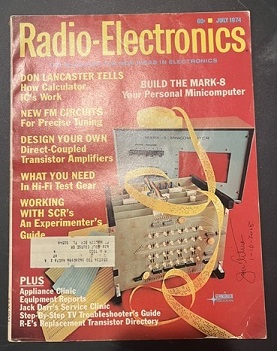
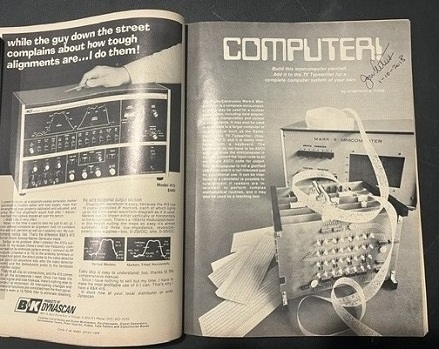
In the warm glow of the MicroBasement, the July 1974 issue of Radio-Electronics stands as the true starting point of the personal computer era. While the Altair 8800 would grab headlines later that year, it was this single magazine issue that first placed real, usable construction plans and programming information directly into the hands of ordinary hobbyists. For the first time, anyone with a soldering iron and basic electronics knowledge could build and program their own computer. The cover story - "Build the Mark-8 Minicomputer" by Jon Titus - gave readers a complete recipe for a working machine and ignited the excitement that would change computing forever.
Radio-Electronics traced its roots to 1929 when Hugo Gernsback - often called the father of science fiction - founded it as Radio-Craft. It was renamed Radio-Electronics in 1948 and became one of the most respected hobbyist magazines of the 20th century, publishing until 2003 (later continuing briefly as Electronics Now). For decades it delivered practical construction projects, theory articles, and the latest in radio, television, and emerging electronics. By the early 1970s the magazine was perfectly positioned to introduce the microprocessor revolution to its readers.
Volume 45, Number 7 (cover-dated July 1974) featured the Mark-8 as its special cover story on page 29. Other articles in the issue included Don Lancaster's "How Calculator IC's Work," new FM tuning circuits, direct-coupled transistor amplifier designs, hi-fi test gear recommendations, an experimenter's guide to SCRs, plus the regular Appliance Clinic, Jack Darr's Service Clinic, equipment reports, and the Replacement Transistor Directory. The magazine also offered a separate 48-page construction booklet for $5.50 and arranged for printed circuit boards to be sold for $47.50, making the project truly accessible.
Jonathan A. Titus (born 1945), a chemistry graduate student at Virginia Polytechnic Institute, designed the Mark-8 in 1972-1973 after working with a DEC PDP-8 minicomputer. Using the newly available Intel 8008 microprocessor, he built a prototype at home. After Popular Electronics declined his article, Radio-Electronics enthusiastically accepted it. Titus wrote the complete construction details and arranged for readers to obtain the necessary boards and booklet. He never sought to commercialize the design himself - his goal was simply to share the excitement of building a real computer.
The Mark-8 was modest by later standards: an 8008-based machine with expandable semiconductor memory, support for an ASCII keyboard or TV Typewriter interface, and a simple front-panel design. Total cost to build was around $250. It was never sold as a complete kit - readers had to source components and assemble it themselves - yet it worked. The article provided full schematics, theory, and programming examples, proving that a useful personal computer could be built at home. The excitement it generated showed hobbyists that computing was no longer limited to giant corporations or universities.
The July 1974 issue of Radio-Electronics represents one of the critical turning points in technological history. By publishing complete, practical plans for the Mark-8, it placed the power to build and program a real computer directly into the hands of average hobbyists for the first time. This modest machine, designed by a graduate student and shared through the pages of a popular magazine, created the excitement and momentum that led directly to the Altair 8800 and the entire personal computer revolution. Preserving and demonstrating this story is essential because it embodies the foundational efforts of engineers and visionaries who created the pathways for modern computing. In the MicroBasement, that yellowed July 1974 issue sits proudly beside an original Mark-8 replica and early Altair hardware - a quiet reminder that the greatest revolutions often begin with a single magazine article and the courage to hand the tools to everyone.