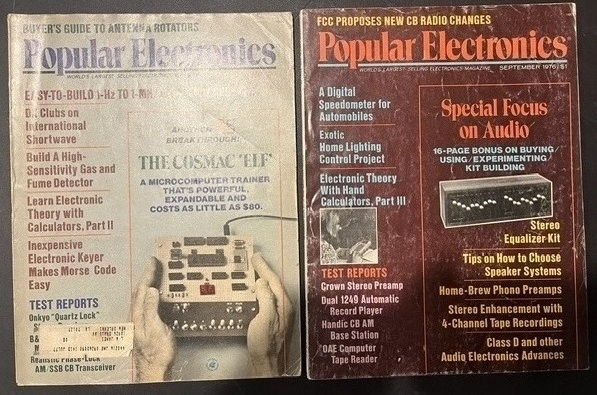
Two issues of Popular Electronics, August and September 1976, carried Joseph Weisbecker's "Build the COSMAC Elf." That is the paper trail for the machine now on the wire-wrap board in the MicroBasement. Part 1 is the computer. Part 2 is the keypad, I/O, and battery backup. Later PE issues added a tiny OS and the 1861 Pixie graphics chip. These two months are the start.
Popular Electronics was Ziff-Davis's mass-market electronics monthly: projects, product tests, ham and audio columns, and the occasional machine that changed the industry. The January 1975 issue put the MITS Altair 8800 on the cover and is usually cited as the shot that started the microcomputer boom. PE was not a scholarly journal. It was a magazine you could buy at a drugstore and take home with a parts list. That is why the Elf landed here instead of in a lab report. Art Salsberg was editor when the Elf ran. The magazine later became Computers & Electronics, then folded into the 1980s PC press.
Joseph Weisbecker was an RCA Labs engineer in Princeton. He designed the COSMAC architecture that became the CDP1802: 8-bit CMOS, 16 general registers, on-chip DMA, a Q output bit, wide supply range, low current. RCA wanted a cheap trainer that a hobbyist could finish for about $80, not another $400 S-100 box. No ROM was required. You loaded RAM through the 1802's DMA path with eight data switches and an Input button. Two hex digits showed the byte. One LED hung off Q.
Popular Electronics Volume 10 Number 2, page 33: "Build the COSMAC Elf - A Low-Cost Experimenter's Microcomputer" by Joseph Weisbecker. Basic machine:
Packaging was left to the builder. PE priced the project around $80. Programs were machine language, keyed in a byte at a time. That is the same ritual as the MMD-1 keypad, just cheaper silicon and CMOS current.
Volume 10 Number 3 continued the build: hex keypad so you could stop flipping eight toggles, more I/O examples, and a 9-volt battery backup so the 256 bytes did not vanish when you pulled the wall pack. That is the issue that turns a trainer into something you can leave loaded overnight.
March 1977 added ETOPS / EHOPS, tiny toggle and hex "operating systems" that ate 32 and 74 bytes of the original 256. Weisbecker also described a 1K RAM expansion. July 1977 added the CDP1861 Pixie for bit-mapped video. RCA later sold the COSMAC VIP as a commercial kit. The PE articles are the open plans. The VIP is the boxed cousin. The MicroBasement Elf is built from the article, with a modern 1861 stand-in in the socket.
January 1975 PE is the Altair cover. July 1974 Radio-Electronics is the Mark-8. August-September 1976 PE is the 1802 path: CMOS, DMA load, hex display, eighty dollars. Same magazine family, different CPU, same idea - print the recipe, let the basement finish the machine.