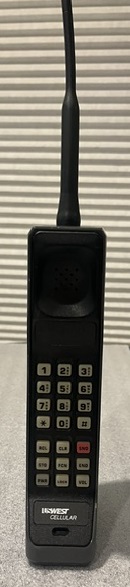
Motorola factory code F09PYD8337AG. That string is a late DynaTAC "brick" - collectors list the same code as a DynaTAC 8000F AMPS handheld. This example is branded US WEST Cellular. Analog 800 MHz, about two pounds, LED display, fixed antenna. In the MicroBasement it sits after the crystal sets and the Globe Patrol: the first time a telephone left the wall and the car and fit in a hand - barely.
DynaTAC means Dynamic Adaptive Total Area Coverage. Martin Cooper's team at Motorola built a handheld prototype and placed a public call in New York on April 3, 1973. The commercial DynaTAC 8000X won FCC type acceptance on September 21, 1983 and went on sale in 1984 at $3,995. Talk time was about 30 minutes. Charge time was about 10 hours. Weight was about 28 ounces. Memory held about 30 numbers. It was nicknamed the brick, or the shoe, for a reason.
Motorola kept the same slab in production, with running changes, through the early 1990s: 8000S, 8000X updates, 8500X, Classic, Classic II, 8000M, 8000F. The MicroTAC flip (1989) and StarTAC (1996) made the brick look prehistoric, but analog DynaTACs were still in catalogs into 1994. This F09PYD unit is that later brick generation, not the 1984 first-run 8000X.
AMPS was FM voice. No SIM card. The phone was programmed to a carrier. When analog service died, the radio died with it.
Bell Labs had sketched cellular reuse in 1947. The working idea waited for computers cheap enough to hand a call from cell to cell. Ameritech Mobile Communications - the wireless arm of the Midwest Baby Bell - turned on the first U.S. commercial cellular system in Chicago on October 13, 1983. David Meilahn placed the ceremonial first call from a Soldier Field parking lot. Most of those first units were car phones. The Motorola handheld followed as soon as the FCC let it.
Utah was not far behind. US WEST's NewVector system went live in Salt Lake City in 1985. Former Governor Norm Bangerter placed the first call from the switch on Wiley Post Way. Salt Lake was the fifth city in NewVector's 14-state territory to get commercial cellular.
For most of the 20th century AT&T (the Bell System, "Ma Bell") was the regulated telephone monopoly: Western Electric built the sets, Bell Labs invented the science, and the local Bell companies owned the wires. The Justice Department sued in 1974. The consent decree was signed in 1982. On January 1, 1984 AT&T gave up the local companies.
Those locals were bundled into seven Regional Bell Operating Companies, the Baby Bells:
US WEST was Mountain Bell, Northwestern Bell, and Pacific Northwest Bell under one holding company: Arizona, Colorado, Idaho, Iowa, Minnesota, Montana, Nebraska, New Mexico, North Dakota, Oregon, South Dakota, Utah, Washington, Wyoming. AT&T kept long distance and Bell Labs. The Baby Bells kept the local loops - and, critically, the new cellular licenses in their territories.
US WEST ran wireless as NewVector (sometimes VectorOne), branded US WEST Cellular on the handsets. In 1994-98 that cellular unit was folded into AirTouch (the Pacific Telesis wireless spinout). Vodafone bought AirTouch in 1999. Bell Atlantic and Vodafone then combined U.S. wireless properties into Verizon Wireless. The wireline US WEST later became Qwest, then CenturyLink / Lumen. The badge on this phone is the 1980s-90s cellular name, not the later PCS "US WEST Wireless" digital relaunch of 1999.
Handsets like this were status objects in the mid-1980s and work tools into the early 1990s. By the mid-1990s flips and digitals took the pocket. Analog AMPS itself was required by the FCC until February 18, 2008. Verizon, AT&T, and most other carriers shut the analog network that week. After that date an AMPS brick is a paperweight. Talk time was never the point of keeping one. The point is the object: two pounds of Motorola, a Baby Bell nameplate, and the first decade of cellular in the Intermountain West.