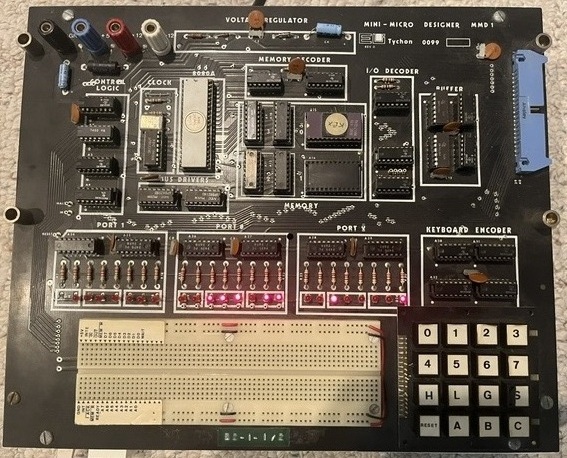
The Mini-Micro Designer MMD-1, introduced in 1976, was an innovative single-board microcomputer kit aimed at educators, hobbyists, and engineers learning microprocessor concepts. Designed around the Intel 8080 CPU, it offered a low-cost, expandable platform for hands-on experimentation with digital logic and programming, bridging the gap between simple trainers and full computers.
The Mini-Micro Designer (MMD-1) was created by computer engineer Jonathan Titus and manufactured by E&L Instruments in 1976. His brother, Chris Titus, wrote the keyboard executive (KEX). It was built as an educational hardware companion to the Bugbooks series.
Released in 1976 for $295 as a kit (bare board $99), the MMD-1 appeared in ads in Byte, Popular Electronics, and Radio-Electronics magazines. It sold several thousand units through the late 1970s. E&L also offered expansion boards and a monitor ROM. Production ended around 1980 as more integrated micros like the TRS-80 and Apple II dominated the market.
The MMD-1 was built around the Intel 8080A microprocessor. Key features included:
Trainer design: octal keypad, LED ports, no video or seven-segment display. This Microbasement unit also drives a 2x40 VFD from a PLD on the expansion header.
Early units shipped bare; users hand-toggled machine code via switches. Optional Tiny BASIC or monitor ROM allowed hex entry/execution. Programs were entered in hex, run, and debugged via single-step. Expansion allowed paper tape I/O or cassette interfaces. Hobbyists wrote games, monitors, and assemblers, sharing via newsletters.
The MMD-1 made 8080 programming accessible at a time when full systems cost thousands. It taught generations of engineers CPU architecture, memory mapping, and I/O timing. While overshadowed by Altair and IMSAI, its compact trainer design influenced later educational boards (e.g., SDK-85). Surviving MMD-1s are rare collectibles, prized for their front-panel interactivity and role in democratizing microprocessor education. Modern replicas and emulators keep its spirit alive in retro communities.