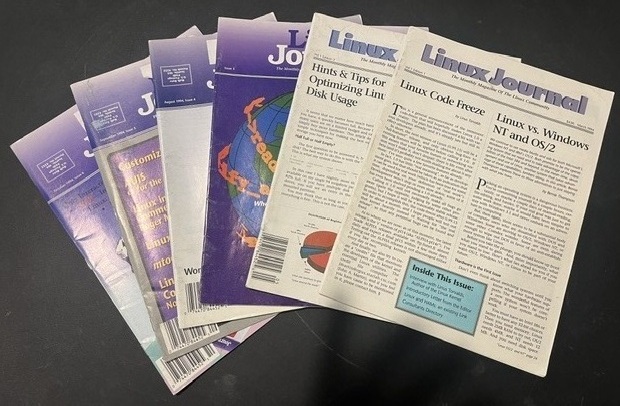
The MicroBasement has the first year of Linux Journal. The photo is the first six issues. March 1994 was Issue 1: an interview with Linus Torvalds, Linux versus Windows NT and OS/2, Debian, What's GNU, Cooking with Linux. The kernel was three years old. Almost nobody in a drugstore knew the word. The magazine treated it like it already mattered.
Phil Hughes started Linux Journal because he thought a free Unix-like kernel needed a print voice. Issue 1 was March 1994, about 48 pages. Robert Young published the first two issues, then left to build Red Hat. Specialized Systems Consultants in Seattle took over. Michael Johnson became editor. Subscriptions started in the hundreds. The first year is still the hobbyist era: source listings, ham radio, make, df, and a student in Helsinki answering questions in print.
Linux began in 1991 as Linus Torvalds's personal project on a 386. He posted to comp.os.minix, shipped source, and accepted patches. No company owned the kernel. The license was GPL. Distributions (Slackware, Debian, later Red Hat) turned a kernel plus GNU tools into something you could install. That is the same stack that ran the 1994 dial-up gateway in this collection: Hayes modem, Slackware, Mosaic. The magazine is the paper trail of that moment.
From that student project and a 48-page first issue, Linux became one of the most significant operating systems ever shipped:
Windows and macOS own many desktops. Linux owns the infrastructure those desktops talk to. That split is the story. A kernel you could read, fork, and fix beat a lot of proprietary Unix that you could only buy.
Byte and Popular Electronics are the 1970s paper. Linux Journal is the 1990s paper. Same job: take something that lived on a mailing list and put it on a coffee table so a basement builder could join. Issue 1 interviewed the author of the kernel. The last issue of a print run is not the point. The first six, when Linux still had to explain itself next to NT and OS/2, are.