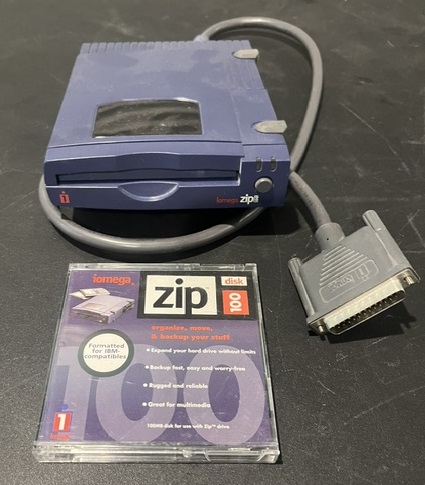
This is an Iomega Zip 100 with a parallel (IEEE 1284) interface. It has been in the collection since the 1990s. At the time it was the practical way to back up files and software and to hand a client a chunk of work that would not fit on a floppy. One disk held 100 MB - about seventy 1.44 MB floppies.
Iomega was founded in 1980 in Roy, Utah (later based in Roy and then San Diego). The company first made Bernoulli Box removable disks for the SCSI / workstation world. Zip, introduced late 1994 and widely sold in 1995, was the product that put Iomega on every PC desk. Drive list was about $199. Extra 100 MB cartridges were about $20 each.
The first Zip 100s out the door were the external parallel-port units. SCSI and ATAPI internals followed. Later came Zip 250 and Zip 750, plus USB. The parallel drive is the slowest of the family (on the order of 0.2 MB/s), but it plugged into a printer port that every PC already had, with a pass-through for the printer.
Parallel Zip 100. External brick, separate wall wart, two 25-pin connectors (host and printer pass-through). Iomega Guest / Tools software on DOS and Windows 3.x / 95 / 98 / NT selected a transfer mode the port could stand. A Parallel Port Accelerator utility could raise the speed if the PC's LPT was willing.
Backup of project trees and software images that were too big for floppies and too awkward for a stack of tapes. File exchange with clients: write the disk, hand it over, they mounted it as another drive letter. That workflow lasted until CD-R and then USB flash made the cartridge unnecessary.
CD-R/RW in the late 1990s, then cheap USB flash and external hard disks in the 2000s. Zip also earned a reputation for "click of death" on some drives and disks. Iomega is gone as an independent company (sold to EMC, later Dell). The Utah origin still matters for a Wasatch collection: this is a local company's shot at owning removable storage.
Between paper tape / 8-inch floppies and a 1 TB laptop drive, Zip is the 1990s answer: a fat floppy that actually held a day's work. The parallel brick is the version that showed up on desks that had no SCSI.