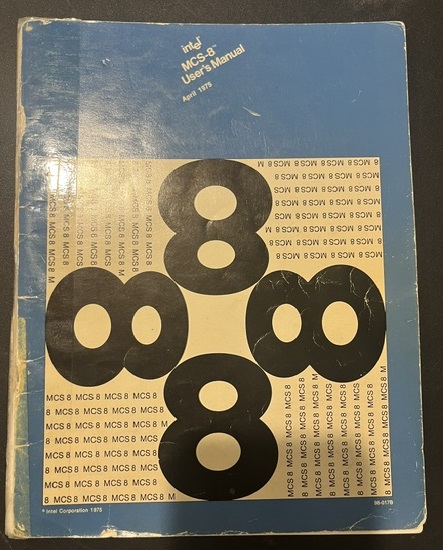
The Intel MCS-8 User's Manual (April 1975, 55 pages) is one of the most important documents in early microcomputer history. This slim booklet provided the complete reference for the Intel 8008 microprocessor - the world's first 8-bit CPU - along with its supporting chip set. In the MicroBasement collection, this manual holds extra meaning: it is my original copy from 1975, sent by Intel while I was designing my own 8008-based computer. The taped cover and worn pages are from real use - late nights at the bench, wiring, debugging, and the first time code ran on hardware I built.
Intel released this manual in April 1975 to support the 8008 after its 1972 introduction. Unlike the earlier 4004 documentation, the MCS-8 manual was aimed at engineers building general-purpose systems, not just calculators. It included full pinouts, timing diagrams, complete instruction sets, programming examples, interrupt handling, and system design guidelines. While it does not provide gate-level schematics, it contains detailed block diagrams of the Intellec 8/Mod 8 development system and the minimal bare-bones 8008/Mod 8 configuration, showing how modules interconnect. This level of detail allowed engineers to treat the 8008 as a standard component - buy the chips, read the manual, and design their own computers, terminals, controllers, or instruments. It was the blueprint that helped turn the 8008 from a niche chip into the heart of early personal computers like the Mark-8 and Scelbi-8H.
The 55-page manual is tightly organized for practical use:
The 8008 (announced April 1972) was the first commercially available 8-bit microprocessor - 3,500 transistors, 48 instructions, 16 KB address space, and the ability to run real programs. It was a huge leap from the 4-bit 4004, enabling true general-purpose computing in a single chip. This manual made it accessible: engineers could now design systems without reinventing every circuit. It was the documentation that mainstreamed the microcomputer - from custom industrial controllers to the first hobbyist machines like the Mark-8 (1974) and Scelbi-8H (1974). The 8008's legacy is in every 8-bit processor that followed.
This modest 55-page manual contained everything needed to design a working computer around the 8008 - block diagrams, timing, instructions, and examples. Today's 64-bit processors require thousands of pages - reference manuals, errata, optimization guides, BIOS specs, and more. The MCS-8 manual proved that a complete, usable microprocessor could be documented in a slim booklet. That philosophy - open, detailed, engineer-friendly documentation - helped launch the personal computing revolution.
The April 1975 MCS-8 User's Manual represents one of the critical turning points in computing history. By providing complete pinouts, timing, instruction sets, programming examples, and block diagrams, Intel gave engineers the tools to build real systems around the 8008 - the first mainstream 8-bit microprocessor. This particular copy is the one I used in 1975. Preserving it is essential because it honors both Intel's documentation and the bench work that turned a 55-page booklet into a running machine. From this document to today's massive processor manuals, the microcomputer journey began here - one carefully wired circuit at a time.