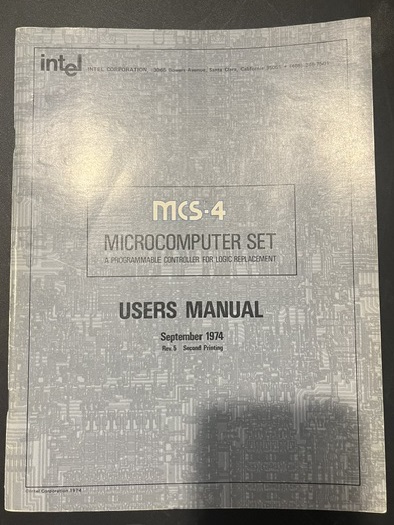
The Intel MCS-4 Microcomputer Set User's Manual (September 1974, Revision 5, second printing) is one of the most important documents in computing history. This 82-page booklet was Intel's complete reference for the world's first commercial microprocessor family - the 4004 CPU plus supporting chips. It gave engineers everything they needed to design real products around a programmable computer-on-a-chip. In the MicroBasement, this manual sits as a foundational artifact - the bridge between the calculator chip that started it all and the personal computer revolution that followed.
Intel published this manual in September 1974 (Rev 5 second printing) to support the MCS-4 family after the 4004's public debut in 1971. Unlike secretive corporate datasheets of the era, Intel provided full schematics, timing diagrams, complete instruction sets, programming examples, and system design guidelines. Engineers could now treat the 4004 like any other component - buy the chips, read the manual, and build custom computers, controllers, terminals, or instruments. This was truly the first mainstream microcomputer documentation - moving the 4004 from a calculator brain to a general-purpose tool.
| Section | Content Highlights |
|---|---|
| Introduction | Applications, economics of microcomputers, MCS-4 features |
| MCS-4 System Description | Overview of the four-chip set (4004 CPU, 4001 ROM, 4002 RAM, 4003 Shift Register) |
| Central Processor Unit (4004) | Architecture, registers, timing, instruction cycle |
| Read Only Memory (4001) | Organization, I/O ports, programming |
| Random Access Memory (4002) | 320-bit RAM, output ports, addressing |
| Shift Register (4003) | I/O expansion, serial-to-parallel conversion |
| Instruction Set | Full 46-instruction repertoire with examples (machine, accumulator, I/O/RAM instructions) |
| Programming Techniques | Subroutines, interrupts, loops, BCD arithmetic, sample programs |
| System Configurations | Memory expansion, I/O interfacing, bank switching |
| Development Aids | Intellec 4 simulator, monitor, assembler, PROM programmer |
| Component Characteristics | Electrical specs, timing diagrams, pinouts |
| Appendices | Instruction summary, ASCII/BCD tables, sample schematics |
The 4004 (announced November 15, 1971) was the world's first commercial microprocessor - a 4-bit CPU with 2,300 transistors, 46 instructions, and the ability to address 4K of program memory and 640 bytes of data. Originally designed for Busicom calculators, Intel realized its general-purpose potential and marketed the complete MCS-4 set. This manual made it mainstream: engineers could now design embedded systems, terminals, cash registers, traffic lights, and early computers without building everything from discrete logic. It was the first time a microprocessor came with full documentation, schematics, and examples - the birth of the "computer on a chip" era.
The humble 82-page MCS-4 manual contained everything needed to design a working system. Today a single 64-bit processor (Intel Core or AMD Ryzen) requires thousands of pages of documentation, reference manuals, errata sheets, and optimization guides. The 4004 manual proved that a complete, usable computer could be documented in a slim booklet. That philosophy - open, detailed, engineer-friendly documentation - helped launch the entire personal computing revolution.
The September 1974 Rev 5 MCS-4 manual represents one of the critical turning points in computing history. By publishing complete schematics, instruction sets, and programming examples, Intel gave engineers the tools to build real products around the 4004 - the first mainstream microprocessor. From this slim 82-page booklet to today's multi-thousand-page processor manuals, the spirit of detailed, accessible documentation lives on. In the MicroBasement, this manual sits beside early 4004 chips, Altair kits, and Mark-8 replicas - a quiet reminder that the personal computer revolution began when Intel handed engineers a complete microcomputer set in one small booklet and said, "Go build something."