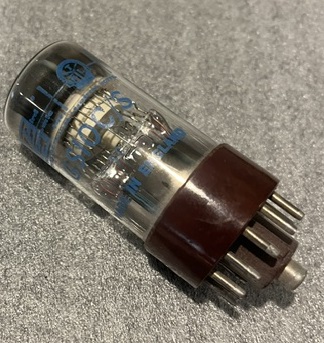
The GS10C/S is a British neon-filled dekatron: a 10-cathode glow-transfer counting tube that both counts and shows the count. The /S suffix is the services (military) mark. Equivalents include CV2325 and Z502S. Makers include Ericsson Telephones Ltd (ETL / Etelco), Hivac, Mullard, and Baird-Atomic. This example is marked Made in England. In the MicroBasement it sits with the Tesla Nomotron as the gas-tube way to count before cheap silicon counters existed.
Dekatrons were invented in the late 1940s by J.R. Acton at Ericsson Telephones Ltd. The first commercial type, the GC10B, appeared in 1950. They were used in the 1950s-1960s for counting, timing, frequency measurement, and decade scalers in instruments and industrial control. The British GS series is ETL's line. Soviet factories made their own dekatron families; those are not this tube. Dekatrons faded in the 1970s as TTL and LEDs took over.
The GS10C/S is a cold-cathode gas tube with ten main cathodes in a ring and a common anode. A neon glow rests on one cathode. Guide electrodes walk that glow one step per pulse pair, up or down. The glowing spot is the digit. Rated speed is about 4 kHz. The B12E duodecal base is the usual British mount, not an octal Soviet base.
The GS10C/S operates on glow-discharge principles:
It was prized for its visual appeal, reliability, and self-contained counting/display in one tube.
Dekatrons like the GS10C/S were used in:
They provided a beautiful, glowing decimal readout without needing separate display tubes.
The GS10C/S is a collector favorite for the moving glow and for the fact that one envelope is counter, memory, and readout. In the MicroBasement it is the British cousin of the Tesla 11TU7: count in the gas, read it by eye.