|
|
|
|
|
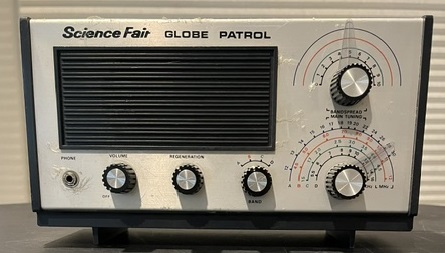
Somewhere between the two crystal sets and a Novice license I wanted more distant signals. Radio Shack "red box" Science Fair kits filled that gap: a one-tube AM radio, an AM wireless microphone, and the one that mattered most - the Science Fair Globe Patrol regenerative shortwave receiver. Four bands. A ground wire and an aerial out the bedroom window. Hours of WWV, foreign broadcast stations, and amateur operators. It was a low-end radio. It was enough to wet the appetite.
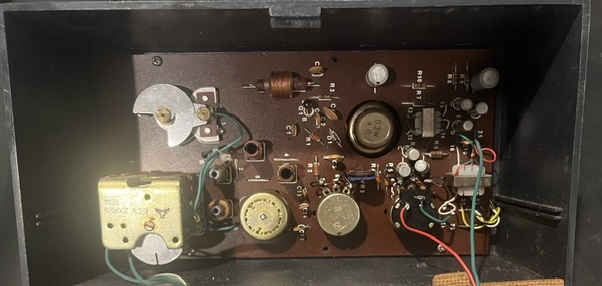
Radio Shack catalog number 28-205, Science Fair Globe Patrol, mid-1970s, about $25. Three transistors (two germanium, one silicon). Four bands with regeneration and bandspread:
Power was four 1.5 V cells. Phones or a small speaker. Made in Japan, sold as a build-it-yourself box with a globe on the panel. An earlier Radio Shack / Archer Globe Patrol used tubes. This one is the solid-state kit.
Edwin Armstrong invented the regenerative detector around 1912-1914. You feed a little of the detector's output back into its input. Gain and selectivity go way up from one stage. Push the feedback far enough and the stage oscillates. That is the squeal. On AM you ride just below oscillation: loud, sharp, and twitchy. Go over the edge and you have a beat note for CW and a way to resolve SSB. The Globe Patrol is that circuit in three transistors.
Other receiver families, short version:
A cheap regen teaches the hand: regeneration knob, bandspread, antenna, and the moment the hiss turns into a station or a whistle. Quality is not high. The lesson is.
WWV on the time ticks. Foreign broadcast on the tropical and evening bands. Amateur CW and SSB when the regen was set just into oscillation. The wire out the window was not a contest antenna. It did not need to be. The first time a voice from another continent comes out of a kit you soldered is the same spark as KSL in the pill bottle, only farther.