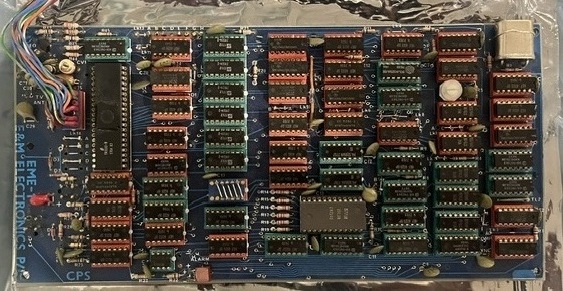
The Electronic Systems TVT (TV typewriter), sold as a stand-alone kit from San Jose, California, is a mid-1970s hobbyist video terminal. The MicroBasement board is the EME-1 from E&M Electronics. It sits with the Don Lancaster TV Typewriter, SWTPC CT-1024, Digital Group video card, and John Bell 8275 as the generation that put characters on a TV instead of a Teletype. This write-up covers the company and kit, display and memory, interface, cursor and editing, power, how it fits the other terminals in the collection, and what the original manual specified.
Electronic Systems advertised the TVT from P.O. Box 21638, San Jose, CA 95151, phone (408) 226-4064. An earlier manual printing used P.O. Box 212, Burlingame, CA, and (415) 573-7788. The kit was a stand-alone TV typewriter: parallel ASCII in, composite video out, no microprocessor on the board. E&M Electronics is the name on the EME-1 hardware in this collection. Like SWTPC and the Digital Group, they sold the plans and boards to builders who already had a keyboard, a +5 V / -12 V supply, and a monitor or modified TV.
On-board memory is 1K (six memory chips, 1024 characters and spaces). The map is thirty-two lines of thirty-two characters. Sixteen lines are visible; sixteen sit off-screen. The cover sheet also lists a modification for 64 characters per line. Characters are a 5 x 7 dot matrix with extra blank scan lines between rows. Output is composite video (horizontal and vertical sync plus video). On-board trimmers set sync lock and horizontal size and position. Vertical position is automatic.
Input is parallel ASCII at TTL levels. Separate on-board ports take a keyboard and a computer output port. A memory-output port lets the host read what is in the screen RAM. The logic decodes ASCII carriage return and line feed so a computer can move the cursor with a single character, the same way it prints text. No RS-232 UART is on the base board; this is a parallel TVT, closer to the Digital Group card than to the SWTPC CT-1024 serial terminal.
The cursor is a flashing white rectangle (can be locked on or made transparent). Controls: up, down, left, right, home, erase to end of line (EOL), erase to end of screen (EOS), scroll up, and scroll down. Auto-scroll: at the end of a line the cursor wraps; at the bottom of the visible page the top line rolls off and a new blank line opens at the bottom. The cursor stays on the visible page. Characters already on the screen can sit off-screen in the extra 16 lines. Single characters are overwritten by parking the cursor and typing. EOL blanks from the cursor to the end of that line. EOS blanks from the cursor to the end of the visible page and leaves the off-screen page alone.
The board needs +5 V at 1.5 A and -12 V at 30 mA. The kit did not include a keyboard, monitor, or supply. Add those and it is a complete terminal for an 8008/8080-era machine with a parallel port.
Lancaster's 1973 Radio-Electronics TV Typewriter started this class: 16 lines of 32 characters, 5 x 7, two pages if you stuffed the RAM. SWTPC turned the idea into the CT-1024 kit with serial I/O. The Digital Group card hung the same idea on a Mark-8 parallel port. The Electronic Systems / EME-1 TVT is that same utility display: 16 visible lines of 32, 1K of page memory, parallel ASCII, composite video. It is the San Jose kit version of the TV typewriter, not a later intelligent CRT controller like the John Bell 8275.
These boards are why early micros could leave the Teletype. The EME-1 is TTL, 1K of character RAM, and a handful of cursor wires. In the MicroBasement it belongs next to the CT-1024 and the Digital Group card: three different shops, same problem, same 16 x 32 answer.