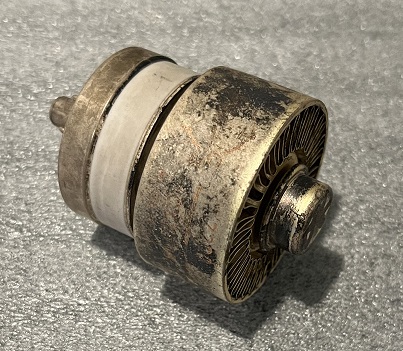
The 4CX250B is Eimac's ceramic-and-metal external-anode radial-beam tetrode. 7203 is the other number on the same bottle (developmental / JAN-style mark). Plate dissipation 250 watts, forced-air cooled, rated to 500 MHz CW. In the MicroBasement it sits next to the glass 4-250A: same dissipation class, a generation later in construction.
Eitel-McCullough (Eimac) was founded in 1934 in San Bruno, California, by Bill Eitel and Jack McCullough to make transmitting tubes that would run at lower voltage and survive amateur and commercial service. By the late 1950s they were building ceramic-metal tetrodes at San Carlos. Varian bought Eimac in 1965; the line later lived under CPI. The 4CX250B became a standard VHF/UHF brick for ham amplifiers, FM, two-way radio, and military gear.
External copper anode, ceramic seals, oxide-coated unipotential cathode, 9-pin special base. Air socket SK-600A and chimney SK-606 are the usual hardware. The anode is the cooling fin stack you see. Compared with the glass 4-250A, this is shorter, lighter, and good much higher in frequency.
VHF/UHF linear and class-C amplifiers, FM transmitters, two-way base stations, some broadcast and military racks. Pairs and sockets show up in classic ham VHF amplifiers. Production ran for decades; NOS and pulls are still common on the surplus market.
Glass 4-250A is the 1940s-1950s HF look: big envelope, 5 V thoriated filament, blower on a tall bottle. 4CX250B is the compact ceramic answer for VHF. Same 250 W plate number, different era of Eimac.