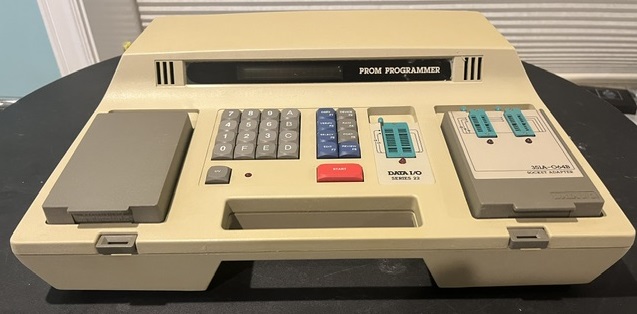
The Data I/O Series 22 is a mid-1980s bench programmer built to burn MOS and CMOS EPROMs, and, with options, EEPROMs, bipolar PROMs, and 40-pin microcomputers. The MicroBasement keeps this one specifically for older parts. Newer universal programmers often drop the algorithms those chips need. The host software that talks to this box runs on a DOS machine over RS-232.
Data I/O was founded in 1969 and incorporated in 1972 in the Seattle area (Redmond). It sold the first commercially available PROM programmer in 1972 and became the shop standard for programming equipment through the System 19, System 29, Series 22, and later UniSite families. The company still exists, now focused on factory programming of flash and secure devices. The Series 22 sits in the era when a 6809, a hex keypad, and a 16-character display were enough to own the firmware bench.
It is a self-contained programmer with its own CPU and RAM. You can load a file from a PC, edit in RAM from the keypad, and program from the front panel. Computer Remote Control (CRC) lets a host drive the same functions over the serial port. That is how the MicroBasement talks to it: a DOS box, a serial cable, and the period software (PROMlink and related tools were written for PC-DOS).
The basic machine programmed more than 150 MOS/CMOS EPROMs. Family and pinout select codes, plus socket adapters, added EEPROMs, fuse-link and AIM bipolar PROMs, and 40-pin MCUs. Data I/O sold RAM upgrades (32K x 8 and 64K x 8), a UV lamp option, and adapters such as the 351A-064 dual 20-pin and 351A-075 40-pin (8741/8748 class).
Modern programmers chase current flash, eMMC, and secure MCUs. They quietly drop 24-pin EPROMs, odd bipolar PROMs, and 8748-class parts. The Series 22 still has those algorithms if the firmware and adapters are present. A DOS host is not a limitation here. It is the native environment: PROMlink on an IBM PC/XT/AT class machine, 192K RAM, one 5.25 in drive, and an RS-232 port.
The MicroBasement collection includes several programmers. This one is the dedicated tool for the vintage inventory: 2716/2732/2764 family work, older MCU EPROM windows, and anything that expects a 1980s Data I/O personality instead of a USB dongle.
Firmware for the MMD-1 display, Tiny 8, Mark-8, and the rest of the 8-bit shelf has to land in real silicon. The Series 22 is the machine that still speaks those parts without arguing.