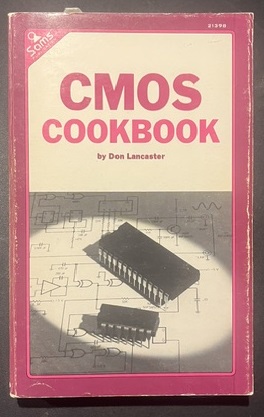
Don Lancaster's The CMOS Cookbook is the follow-up to his TTL Cookbook. Howard W. Sams published it in 1977 (Sams 21398). 416 pages. It introduced hobbyists and experimenters to the Complementary Metal-Oxide-Semiconductor logic family. CMOS brought ultra-low power, a wide voltage range, and high noise immunity. That combination made it the preferred choice for battery-powered projects, portable instruments, and eventually most modern digital electronics. In the MicroBasement collection this book sits beside the TTL volume - two books that together taught a generation how to think in logic gates and build working circuits.
Don Lancaster (1939-2023), the same author as The TTL Cookbook, released The CMOS Cookbook in 1977. Howard W. Sams again. It stayed in print for decades. Lancaster's style turned manufacturer datasheets into circuits you could actually wire. TTL still dominated the early 1970s 5 V boards. CMOS was the next step for low-power and portable designs, and hobbyists needed a guide that was not a stack of RCA and Motorola data books.
The book is organized for reference and for the bench. It begins with CMOS fundamentals: how complementary P- and N-channel MOSFETs work, logic levels, power-supply requirements (3-15 V typical), static protection, interfacing with TTL, breadboarding, and testing. Later chapters cover the popular 4000-series CMOS ICs in detail: inverters, gates, flip-flops, counters, shift registers, multiplexers, decoders, analog switches, monostables, oscillators, voltage-controlled oscillators, phase-locked loops, and display drivers. Later sections go into applications: digital frequency meters, touch switches, electronic music, TV typewriter interfaces, power-supply regulators, and complete project ideas. Appendices include pinouts, cross-reference charts, and manufacturer listings.
What made the book useful was the shop detail: ESD sensitivity, decoupling, pull-up and pull-down resistors, level shifting between TTL and CMOS, driving LEDs and relays, astable and monostable timers, and low-power clocks. Lancaster explained why CMOS won battery work (nanoamp quiescent current in many parts), how to avoid latch-up, and how to mix CMOS with TTL or discrete parts. The projects were buildable with 1970s catalog parts - amateur radio, instrumentation, and early microcomputer interfacing.
By walking through the 4000-series family and showing how to use it, Lancaster helped move builders from power-hungry TTL to the low-power logic that now sits in almost every battery-powered digital device. In the MicroBasement the dog-eared copy rests next to the TTL Cookbook, early CMOS chips, and the machines that ran both families.