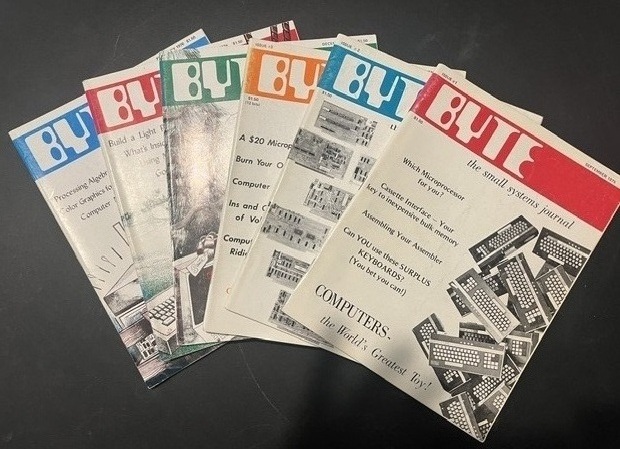
Byte Magazine was the voice of the personal computing revolution. Launched in September 1975 by Carl Helmers as a one-man newsletter and quickly acquired by McGraw-Hill, it became the premier publication for microcomputer enthusiasts. The first sixteen issues (September 1975 through December 1976) provided technical depth, hardware reviews, software listings, and forward-looking articles when almost no other source existed. In the MicroBasement collection, these early Byte issues - from the original mimeographed Sept 1975 flyer through the December 1976 professional transition - sit as treasured artifacts. They brought cutting-edge information - previously locked in labs, newsletters, or word-of-mouth - directly to basement builders and experimenters everywhere.
Carl Helmers published the first issue (Vol 1 No 1) in September 1975 as a 4-page flyer titled "Byte" for the Homebrew Computer Club community. By issue 2 it had grown to 20 pages; by issue 6 it was a full magazine. McGraw-Hill acquired Byte in late 1975, and from issue 7 onward it became a glossy, professional publication. The run from September 1975 to December 1976 (Vol 1 No 1 through Vol 2 No 4) captures the purest hobbyist era - typewritten, mimeographed, and packed with raw technical content before commercialization took hold.
| Issue | Date | Key Articles & Contents |
|---|---|---|
| Vol 1 No 1 | Sept 1975 | Introduction to Byte, Altair 8800 overview, 8008 machine language primer, simple I/O circuits, reader survey |
| Vol 1 No 2 | Oct 1975 | Altair 8800 construction details, TV typewriter concepts, 8008 instruction set, memory expansion ideas, BASIC language introduction |
| Vol 1 No 3 | Nov 1975 | Altair software notes, paper tape reader interface, 8080 vs 8008 comparison, simple monitor program listing, keyboard encoder |
| Vol 1 No 4 | Dec 1975 | TV typewriter construction, cassette interface, 8080 assembler listing, memory mapped I/O, reader projects |
| Vol 1 No 5 | Jan 1976 | Altair 8800 expansions, floating-point routines, video display generator, Tiny BASIC source code, serial I/O |
| Vol 1 No 6 | Feb 1976 | IMSAI 8080 review, floppy disk interface concepts, 8080 interrupt handling, game programs, reader feedback |
| Vol 2 No 1-4 | Mar-Dec 1976 | Apple I/II announcements, S-100 bus standards, floppy disk controllers, early CP/M notes, more Tiny BASIC variants, reader-built systems, growing software listings |
Before Byte, microcomputer information was scarce - scattered in newsletters like the Homebrew Computer Club proceedings, vendor flyers, or word-of-mouth at meetings. Byte changed that. The first sixteen issues delivered schematics, code listings, hardware reviews, and tutorials when most hobbyists had never seen an Altair up close. Readers could build TV typewriters, cassette interfaces, memory boards, and even write their own monitors and assemblers. Byte made knowledge that was previously locked in corporate labs or university projects available to anyone with a soldering iron and curiosity. It fueled the explosion of homebrew systems, spurred the creation of software like Tiny BASIC, and helped turn the microcomputer from a kit into a movement.
The first sixteen issues of Byte Magazine represent one of the critical turning points in personal computing history. By publishing detailed technical information, schematics, and source code when almost no other outlet existed, Byte empowered hobbyists to build, program, and expand their own machines. It bridged the gap between the Mark-8/Scelbi era and the Altair explosion, giving builders the knowledge they needed to create the future. Preserving these early issues is essential because they embody the foundational efforts of publishers and contributors who democratized cutting-edge technology. In the MicroBasement, these sixteen fragile, mimeographed magazines sit alongside Altair kits, Mark-8 replicas, and Scelbi hardware - a quiet reminder that the personal computer revolution began with a few pages of typewritten text and the willingness to share what was possible.