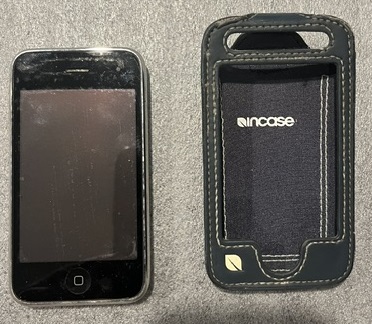
Apple model A1241. Internal name iPhone1,2. Announced June 9, 2008 at WWDC. Sold July 11, 2008. This is the second iPhone: plastic back, 3G radio, GPS, and the App Store on day one. The photo shows it in a leather case - the first iPhone that enough people carried every day to wear a holster instead of a shrine box.
Jobs' line at WWDC was the whole pitch. The original A1203 had been $499 / $599. The 3G launched at $199 (8 GB) and $299 (16 GB) with a two-year AT&T contract. White 16 GB joined black 8 and 16. Same 3.5 inch 320 x 480 glass. Same ARM11 clocked at about 412 MHz and 128 MB of RAM. The new work was in the radio and the software.
July 11 was another sidewalk day. Apple and AT&T stores ran out. Activation servers fell over. The difference from June 29, 2007 was volume: this was the iPhone priced like a phone, not like a luxury iPod that happened to call.
Still no video recording, no front camera, no copy-and-paste until later OS updates, no flash. Camera stayed 2 MP. Battery was smaller on paper (about 1150-1220 mAh) because 3G is hungry: Apple quoted 5 hours talk on 3G, 10 hours on 2G, 300 hours standby.
U.S. carrier at launch was still AT&T. Sold in 22 countries on day one, more than 70 by the end of the year. The 8 GB 3G stayed in the lineup as a low-price model after the 3GS arrived in June 2009, then left in June 2010.
A1203 invented the rectangle. A1241 made it a product. 3G made Maps and the browser usable away from Wi-Fi. GPS put a blue dot on the map. The App Store turned the home screen into a platform. That is the phone that ended the argument about whether a touch slab could replace a BlackBerry for mail and a Garmin for directions. The leather case in the photo is the tell: this one left the desk and went in a pocket.