|
|
|
|
|
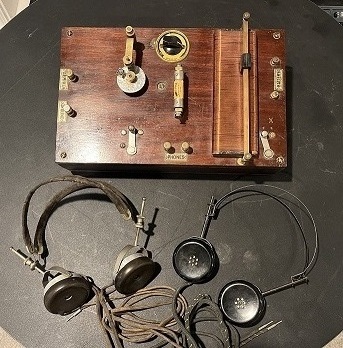
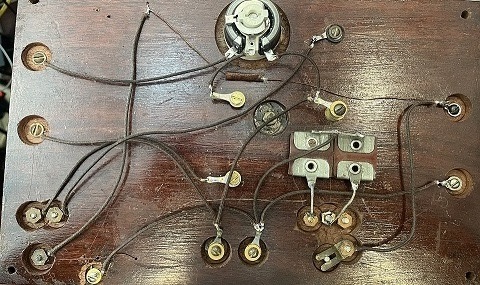
This is a mid-1920s basement crystal receiver. Mahogany panel, wood coil form, Electro Importing Co. labels, two galena cat-whisker stands, and a Carborundum Company No. 30 cartridge from Niagara Falls. A battery bias feed and potentiometer sit on the panel because carborundum wants a volt of forward bias. Two period headsets ride with it: Brandes and Cannon-Ball Dixie. In the MicroBasement it sits with the coherer and the later comm gear - the no-tube way you first heard a broadcast station.
Best window is about 1924-1927. The No. 30 Carborundum detector sold for $1.50 and shows up in 1925 ads and boxed examples. The mica condensers, bias pot, and dual-detector layout match magazine projects from that same stretch. The E.I. Co. NY nameplates are a little older. Electro Importing (Hugo Gernsback, Park Place and later Fulton Street) pushed terminals, sliders, and labels from 1905 into the early 1920s. A builder in the broadcast boom often mixed leftover E.I. hardware with a new Carborundum cartridge. This board looks like that mix, not a 1914 spark set and not a 1930s Scout kit.
The slide coil and optional mica cap tune the antenna-ground circuit. One detector at a time rectifies the RF. Galena is the classic whisker mineral: fussy, no battery. Carborundum (silicon carbide) is a hard, factory-set contact. It stays put when the table shakes, which is why ships and commercial stations liked it after Dunwoody's 1906 patent. The wide band gap wants a small forward bias, hence the dry cell and pot. Headphones close the audio path. No tubes, no B+.
Brandes (usually the Superior) was the common 2,000-ohm pair of the 1920s. Cannon-Ball Dixie came from C.F. Cannon in Springwater, New York - another high-impedance magnetic headset sold to the same catalog trade. Either pair is correct on this board.
E.I. Co. was Gernsback's first radio storefront: Telimco spark sets in 1905, then catalogs full of coils, detectors, and nameplates. By the time this set was wired, Gernsback's energy had moved to the magazines. The brass labels are what a careful builder screwed on so the panel looked finished.
The coherer is the pre-broadcast detector. This board is the AM-broadcast crystal set: slide tuner, choice of minerals, and a branded Carborundum cartridge you could buy for a dollar-fifty. Later pages are tubes, then silicon. Same job - pull a voice out of a wire - three different decades of parts.