|
|
|
|
|
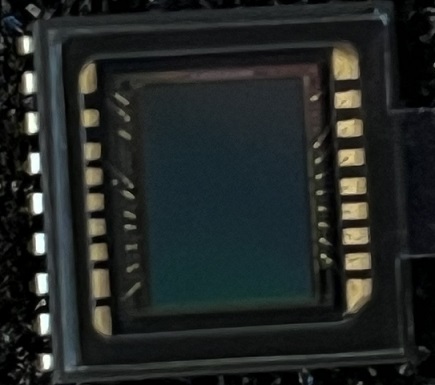
The MN39482PJ is a 1/2.5-type interline-transfer CCD made by Panasonic for digital still cameras in the early 2000s mega-pixel wave. About four million photosites live on a die a few millimeters across. That is the same job the Image Orthicon, Plumbicon, Newvicon, and Vidicon did with glass, high voltage, and a scanning beam - except the CCD is a plastic DIP you can hide under a postage stamp.
Square-pixel color CCD for DSC use. Horizontal CCD clocks at 3.3 V to keep power down. Panasonic sold it as part of the high-performance mega-pixel still-camera family, with matching timing and analog front-end chips.
The whole package is under 1 cm square and a few grams. Supply is low-voltage logic and analog rails, not kilovolts. No yoke, no focus coil, no 400 V target, no 6 kV IO multiplier.
The collection already has the analog cameras that owned professional pictures from the 1940s through the 1980s. This chip is what ate them. Same photons in, voltage out - without a glass bottle the size of a flashlight or a camera the size of a suitcase.
Tubes do not have pixels. They scan a continuous target. "Resolution" below is the usual TV-line / picture-quality class those tubes were sold for, not a pixel count. NTSC visible picture is roughly 480 lines. A 4 MP still CCD samples the scene on a grid of about 2300 x 1700. That is not a fair one-number fight. It is the point.
| MN39482PJ CCD | RCA 7293A Image Orthicon | Philips XQ1073X Plumbicon | Newvicon S4075 | Philips XQ1600 Vidicon | |
|---|---|---|---|---|---|
| When | early 2000s DSC | late 1940s-1960s broadcast | late 1960s-1980s broadcast color | 1970s-1980s industrial / low light | 1960s-1980s CCTV / portable |
| Sensor size | 1/2.5 type; 5.76 x 4.32 mm image | 3-inch faceplate; tube ~15 in long | 1-inch faceplate; tube ~8-9 in long | 1-inch faceplate; similar 1-inch body | 1/2-inch faceplate; ~3 in long |
| Weight of the sensor | a few grams | on the order of a pound of glass and metal | several ounces | several ounces | an ounce or two |
| Resolution class | ~4 MP still (2304 x 1728 active) | broadcast 525/625-line; high-end IO ~400-600 TVL class | broadcast color; good 400+ TVL class, low lag | industrial / CCTV; better lag than plain vidicon | ~400-500 TVL class compact vidicon |
| Power / voltages | 3.3 V H-CCD plus low-voltage analog; milliwatts-to-watts in a camera | thousands of volts (image + multiplier); tens of watts in the CCU | target ~300-500 V plus yoke; camera/CCU tens of watts | target ~300-500 V plus yoke | target ~300-500 V; smaller draw than 1-inch types |
| Camera that held it | pocket / compact DSC; a board the size of a credit card | studio or field IO camera: large head, thick cable, CCU rack; color needed three tubes; 50-80+ lb class systems | three-tube color studio or OB camera; still a two-hand head plus CCU | one-tube industrial / medical / security brick | small CCTV or portable head |
| What you got | a still frame you can store as a file; no warm-up; no alignment coils | live broadcast in moonlight-class light if you had IR-ish IO sensitivity and a crew | clean color, low lag, the look of 1970s network TV | workable pictures in dim industrial light | cheap eyes on a factory floor |
| What it costs you | a clock chip and a lens | HV, yoke, alignment, spare tubes at $1,200-$2,000 (1960s), hours of life | three matched tubes, prism, CCU | yoke and target supply | yoke and a small supply |
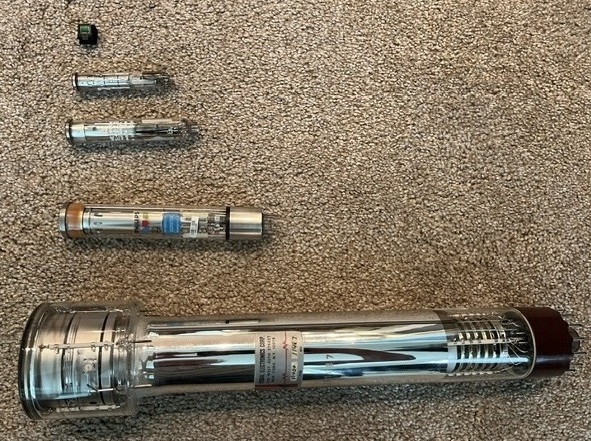
Stack the four tubes on the bench and they outweigh and out-volume a bag of these CCDs. The 7293A camera would not fit through a modern front door with the CCU. The XQ1073X lived in a color camera that still needed a cart. The Newvicon and the 1/2-inch XQ1600 got the camera down to something you could hang on a wall. The MN39482PJ got the camera into a jacket pocket and raised the sample grid from "a television line" to four million sites.
That is the cool part. Same photons. One path is a 15-inch bottle and a room of power supplies. The other is this DIP.