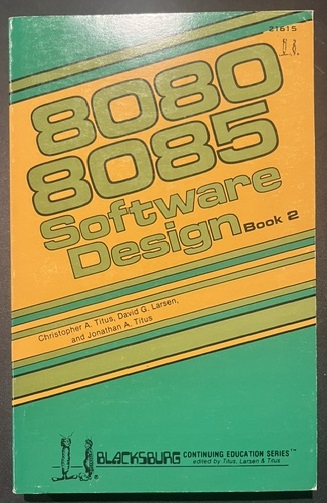
Book 2 of the 8080/8085 Software Design series takes the foundation from Book 1 into larger programs and system integration. Published in 1980 by Howard W. Sams & Co., this 352-page paperback covers advanced assembly techniques, modular software design, interrupt-driven systems, and complete application examples for the Intel 8080 and 8085. Same four authors. It is the next step after Book 1 if you were ready to write firmware that had to live on the board, not just a delay loop and a dump routine. In the MicroBasement collection this sequel sits beside Book 1, the 8085A Cookbook, and the 8080/8085 hardware.
Published in 1980 by Howard W. Sams & Co. as part of the Blacksburg Continuing Education Series. Same four authors as Book 1:
The Titus brothers, Larsen, and Rony were already deep in Virginia Tech's microprocessor courses. Book 2 is written for people who finished Book 1, for upper-level students, and for anyone putting an 8080 or 8085 into a controller that had to keep running.
Book 2 assumes Book 1 and goes to structured programming in assembly, macros, relocatable code, modular design with overlays, a first look at multi-tasking, and interrupt handling in detail - vectored interrupts, priority, nested interrupts. Chapters cover data structures (queues, stacks, linked lists), table-driven programming, floating-point emulation, size and speed optimization, and real-time design. Later sections are whole applications: a full monitor, serial handlers, data-acquisition routines, motor-control algorithms, and process-control examples. Extensive listings, flowcharts, memory maps, timing analysis, plus appendices with expanded instruction tables, opcode summaries, and debugging notes.
The authors stay on code you can maintain: conditional assembly, parameter passing, error handling, and comments that still mean something six months later. Projects are aimed at real hardware - SDK-85, homebrew boards, IMSAI-class machines - with interrupt-driven I/O, tight timing loops, and the reality of a small memory map. Troubleshooting covers race conditions, stack overflows, and interrupt fights. That is the jump from a utility to a firmware package.
Book 1 is the instruction set and the first working programs. Book 2 is structure, interrupts as a system, and applications that fill a ROM. Together they sit with the 8085A Cookbook, TEA, the Bugbooks, and the 8080/8085 machines. Blacksburg software shelf, both volumes.