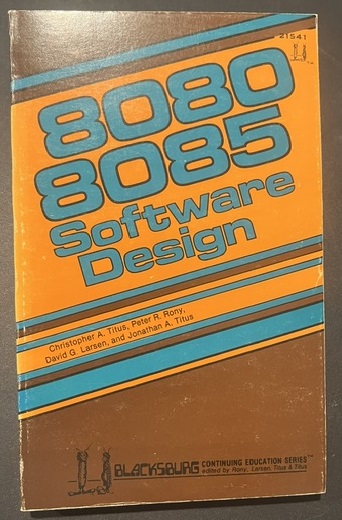
The 8080/8085 Software Design series is one of the most used microprocessor programming guides of the late 1970s and early 1980s. Book 1, published in 1979 by Howard W. Sams & Co., is a practical foundation in assembly-language programming for the Intel 8080 and 8085. Four authors. It sits between the hardware datasheet and code that actually runs: monitors, utilities, and control programs. In the MicroBasement collection this volume sits beside the 8085A Cookbook, the 8080/8085 hardware, and the other Titus interfacing titles.
Published in 1979 by Howard W. Sams & Co. as part of the Blacksburg Continuing Education Series. Book 1 was a collaborative effort by four people who already taught this family of chips:
The Titus brothers - Jonathan of the Mark-8 and Christopher of TEA and the 8085 software titles - worked with Larsen and Rony, Virginia Tech faculty and regulars on the Blacksburg books. The audience was students, hobbyists, and anyone building an 8080 or 8085 system who needed more than a pocket opcode card.
The book is a progressive path. It begins with microprocessor fundamentals: 8080/8085 architecture, instruction set, addressing modes, registers, stack operations, interrupts, and timing. Chapters cover assembly techniques: data movement, arithmetic and logic, branching and loops, subroutine calls, bit manipulation, and modular programming. Later sections are applications: delay loops, table lookups, BCD arithmetic, interrupt service routines, serial I/O, memory-mapped I/O, and debugging. There are hundreds of code examples, flowcharts, timing diagrams, and complete programs (monitors, math utilities, I/O drivers), plus appendices with the 8080/8085 instruction set, opcode tables, and ASCII charts.
Every concept is illustrated with code you could type in and run on real hardware - Altair 8800, IMSAI, SDK-85, or a homebrew board. The authors spend time on the problems that actually bite: carry-flag handling, stack overflows, interrupt priority, and how to trade speed against code size. It is usable as a first assembly book and still dense enough for firmware that has to live on a small ROM. It showed up in college courses and on self-taught benches for the same reason.
Book 1 is the instruction set and the first working programs. Book 2 goes after structure, interrupts as a system, and larger applications. Together they sit with the 8085A Cookbook, TEA, the Bugbooks, and the 8080/8085 machines on the floor. That is the Blacksburg software shelf for this CPU family.