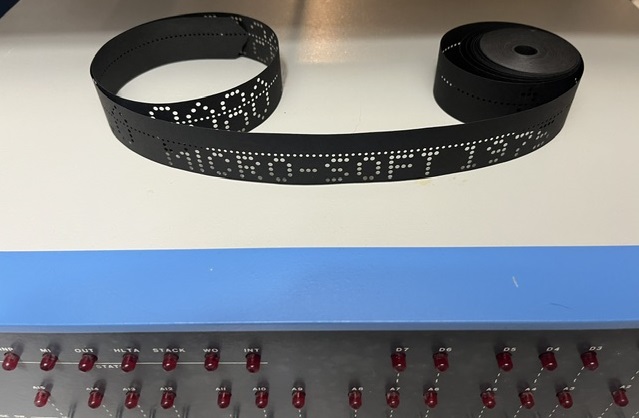
In the warm glow of the MicroBasement, few artifacts capture the dawn of personal computing quite like the original 4K 8080 Microsoft BASIC 1.0 delivered on punched paper tape for the Altair 8800. This modest roll of tape - roughly 34 feet long - carried the very first commercial high-level programming language ever written for a microcomputer. Suddenly, ordinary hobbyists could sit down at their $397 Altair kit and actually program it in plain English instead of raw machine code. In the MicroBasement, this humble paper tape represents the moment the personal computer stopped being a toy for engineers and became a tool for everyone.
Before Microsoft BASIC, every Altair owner had to toggle programs into the front panel switches in octal or hex - a tedious, error-prone process limited to a tiny group of experts. BASIC changed everything. It was interactive, easy to learn, and powerful enough for real applications. Users could type simple commands, edit programs on the fly, and run them immediately. This single language turned the Altair from a blinking light show into a true "personal" computer that anyone could use for calculations, games, education, and early business tasks. It proved that high-level languages belonged on microcomputers and set the standard that every personal computer would follow.
In January 1975 Bill Gates and Paul Allen saw the Altair 8800 on the cover of Popular Electronics. They immediately called MITS in Albuquerque and claimed they had a BASIC interpreter ready for the 8080. It was a bold bluff. Working in a Harvard dorm room and using a PDP-10 simulator, they wrote the entire interpreter in just eight weeks. Paul Allen flew to Albuquerque in March 1975 with a paper tape of the finished program. It loaded perfectly on the first try. Micro-Soft (the original hyphenated name) was officially formed as a partnership on April 4, 1975. This 4K version (later expanded to 8K and Extended) shipped to customers in July 1975.
MITS (Micro Instrumentation and Telemetry Systems) signed a non-exclusive licensing agreement with Gates and Allen on July 22, 1975. Microsoft received a $3,000 upfront payment plus royalties: $30 for each 4K copy, $35 for 8K, and $60 for the Extended version. MITS sold BASIC directly to Altair owners for $150 (4K paper tape), $200 (8K paper tape), and $300 (Extended). Discounts brought the price as low as $75 when bundled with memory boards. Customers received the tape, loaded it via the Altair's optical paper-tape reader (or manually entered a short bootstrap loader), and suddenly had a working BASIC interpreter.
Within weeks, copies of the paper tape were being passed around at the Homebrew Computer Club and other hobbyist groups. Many users simply duplicated the tape and gave it away free. Bill Gates responded in February 1976 with his famous "Open Letter to Hobbyists," arguing that unpaid software was theft and that the royalties received so far amounted to less than $2 an hour for the time invested. The letter sparked intense debate in the hobbyist community and is now seen as a pivotal moment in the history of commercial software. Despite the controversy, the bootlegging helped spread BASIC rapidly and ultimately grew the entire personal computer ecosystem.
The very first version shipped exclusively on paper tape - the only practical storage medium the original Altair supported out of the box. At the standard density of 10 characters (bytes) per inch on 8-channel tape, the 4K BASIC required roughly 34 feet of tape. Shortly afterward, MITS offered the same BASIC on audio cassette tape (using the optional 88-ACR cassette interface board). Cassette versions were slightly more expensive but far more convenient for users who added the interface. Both formats contained identical code; only the delivery medium changed. Later ports to other machines (IMSAI, Sol-20, etc.) continued the paper-tape and cassette tradition until floppy disks took over.
Microsoft BASIC 1.0 on paper tape marks the exact moment commercial software for personal computers was born. It transformed the Altair from a hobbyist curiosity into a practical machine, launched Microsoft as a company, and ignited the fierce debate about software ownership that still echoes today. Preserving this early version - with its paper-tape roots and its role in both innovation and controversy - is essential because it embodies the foundational efforts of the engineers and visionaries who created the pathways for modern computing. In the MicroBasement, that humble roll of tape sits proudly beside the Altair itself, a silent reminder that the personal computer revolution began with a few feet of punched holes and a bold idea that anyone should be able to program their own machine.